

Book One · The Hollowell Moral Thriller
“She knows who killed him. The law says she can’t tell.”
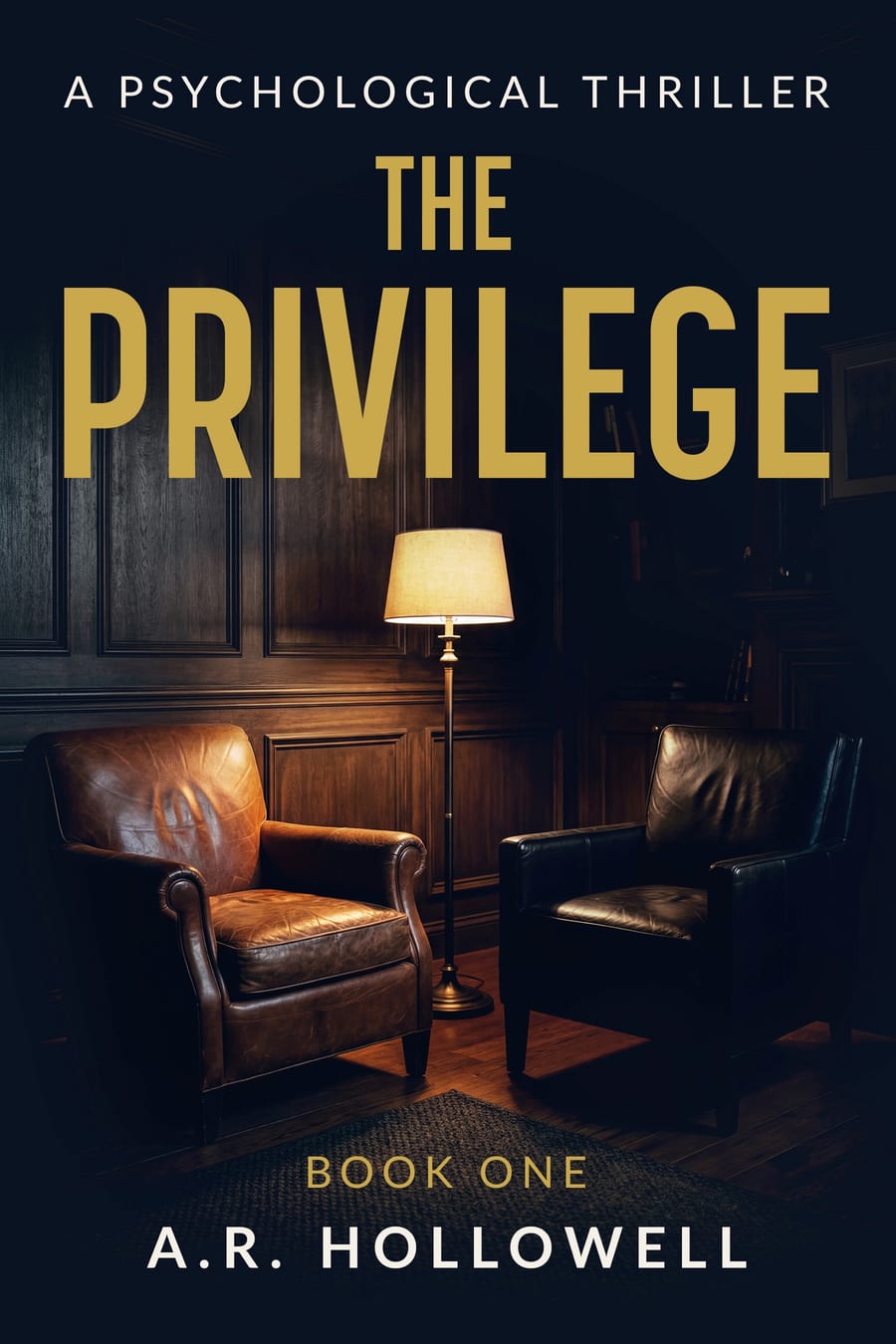
The Privilege
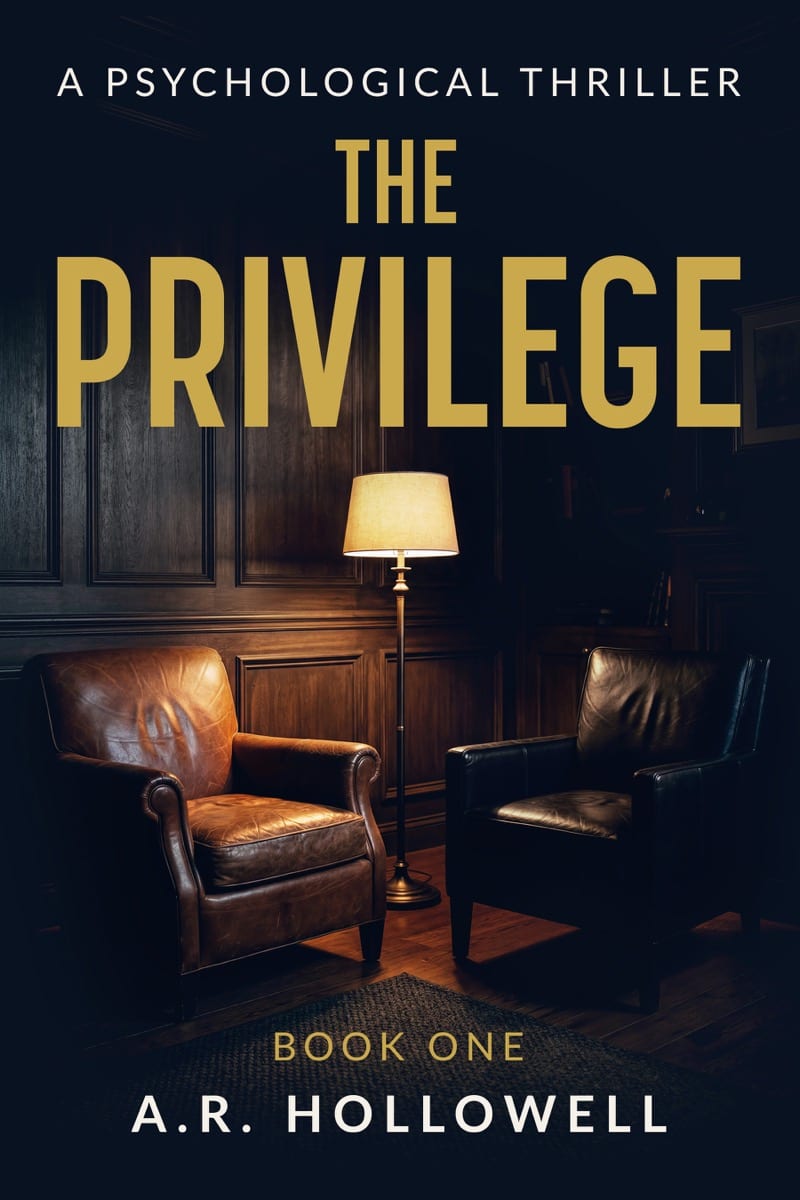
Book OneThe Hollowell Moral ThrillerA.R. Hollowell
“She knows who killed him. The law says she can’t tell.”
Listen to the blurb
0:00/1:38
Chicago therapist Elena Vargas keeps hundreds of secrets for a living. People sit in her chair, confess the worst thing they’ve ever done, and trust her to hold it. Then a patient confesses to a fatal hit-and-run. At the door he adds, “He had a mother. Diane. Retired teacher. Lives alone in Evanston.” And he walks out like nothing happened.
Three days later, the victim’s mother is referred to Elena, who says yes so she can watch over her. Now Diane sits in the same chair, searching for answers about her son’s death, answers Elena already has. When Diane asks if the driver will ever be found, Elena says, “I hope so.” Her first lie.
Every Tuesday: the mother, searching for the truth.
Every Thursday: the killer, making sure it stays buried.
The law says the confession is protected. The privilege is absolute. But when the killer starts watching the mother from across the street, the rules meant to protect become the walls that trap Elena.
Now Elena faces an impossible choice: break the law and destroy her career, or keep the secret and risk a mother’s life.
A gripping psychological thriller about the secrets a therapist must keep, a mother’s grief, and the moment silence becomes a crime.
The Privilege is Book One of the Hollowell Moral Series.
For fans of Jodi Picoult and Lisa Scottoline.
Get your copy
Save it on GoodreadsKindle: read free with Kindle Unlimited · Signed by hand, U.S. delivery · Save on Goodreads
At a glance
- Slow-burn moral suspense
- Therapist-patient privilege
- The duty to warn
- A mother's grief
- Moral dilemma
- Confession
- Hit-and-run
- Cat and mouse
- Dangerous secret
The Privilege
$0.99Kindle
- Pages
- 230
- Published
- June 2, 2026
- ISBN
- 979-8995749806
- Publisher
- Armitage Press
- Series
- The Hollowell Moral Thriller · Book One
The complete series
Also in The Hollowell Moral Thriller
- You are here
Book One
The Privilege
Kindle Unlimited 
Book Two
The Testimony
Kindle Unlimited
Book Three
The Witness
Kindle Unlimited
Official Trailer
Case file · Chapter One
The Privilege
13 min read
The notepad on the arm of Elena’s chair was blank. An hour of listening and she had written nothing, because writing would have been evidence and evidence would have been a violation and the violation would have been hers, not his. The pen was still in her hand. Her fingers had gone white around it.
The office smelled faintly of cedar. Something expensive. The smell would fade by morning. The name would not.
Ryan Hollowell. Twenty-four years old. Graduate student. Died at the scene.
Elena Vargas sat in the chair and did not move. She had kept secrets for fourteen years; it was, in a sense, the entire job. People came to her office and set down the heaviest thing they owned, and she held it for them until they were strong enough to pick it up again. She had never dropped one.
The man who had just left her office had not set anything down. He had placed it inside her, deliberately, like hiding a document in someone else’s safe. And then he had smiled at the door, checked his watch, and asked about next Thursday.
Her hands were cold. Her chest was tight. The radiator ticked in the corner. The yoga studio below had gone quiet.
It was a Thursday in November, and everything before 4 PM belonged to a different life.
She had driven to work that morning the same route she always drove: Lake Shore Drive to Fullerton, Fullerton to Armitage, the route so familiar her hands made the turns without consulting her brain. The lake was gray. The sky was gray. November in Chicago was a month of grays, the city pulling its color inward, saving it for the interiors: the warm restaurants, the lit apartments, an office where Elena spent her days listening to people describe the shapes of their pain.
She climbed the three flights. The elevator had been broken since August; the landlord had stopped returning calls. She unlocked her office. The amber lamp. The two leather chairs. The window overlooking the maple tree, which was, this time of year, losing its leaves with a kind of exhausted dignity, one at a time, as if each letting-go required a separate decision. Elena liked the office best in the mornings, before the chairs filled with other people’s lives. The quiet had a texture to it: the faint smell of lavender drifting up through the floorboards.
The day was ordinary. Three clients. A woman working through her mother’s death brought a photograph and talked to it twice before remembering Elena was in the room. A college student with panic attacks carried a paper bag in her backpack like a talisman. A couple whose marriage was dissolving sat on opposite ends of the couch and used each other’s first names with exaggerated care, the politeness that precedes the paperwork. Between sessions Elena ate the same salad she brought every day: spinach, walnuts, dried cranberries, the dressing in a separate container because soggy lettuce was a line she refused to cross. Her 3 PM cancelled. She walked to the corner shop for a decaf; the barista called her Dr. V.
At ten to four she settled into her chair with the coffee cooling in her hands and watched the maple tree surrender another leaf to the wind. The brownstone was quiet. A siren passed on Armitage, distant, fading east toward the hospital. Four minutes of stillness, the last that would belong entirely to her.
The buzzer rang at 4:01 PM. One minute late. Thomas Crane was never late; the first two sessions he had arrived at exactly 4:00. One minute late meant a shift. Elena noted it as she noted everything: quietly, without judgment, filing it in the part of her mind that tracked patterns. She said nothing. She opened the door.
Her office was on the third floor of a brownstone on Armitage Avenue, next door to a wine bar that was closed in the afternoons. A small, warm room. The radiator ticked in the corner, the sound clients sometimes mistook for a clock.
Thomas Crane sat in the chair across from her, his coat folded neatly on the arm of the chair, his legs crossed at the ankle. Dark hair going silver at the temples. Mid-forties, maybe older. A jaw that looked like it had been designed to convey authority. He wore a charcoal suit without a tie, the top button undone, and he kept his hands in his lap with a stillness that looked practiced.
Elena had seen practiced stillness before. Patients who arrived with their disclosure already packaged: the words chosen, the sequence rehearsed, the body controlled too carefully. The effort of appearing effortless. She noted it the way she noted everything, clinically, without judgment. A data point. She filed it.
She would remember filing it later.
Third session. The first two had been careful: work stress, insomnia, a general unease he couldn’t name and didn’t seem interested in naming. Elena had listened and waited, because the thing people came in saying was almost never the thing they actually needed to say. The presenting complaint was the door. The real issue was the room behind it.
She’d been waiting for him to open the door.
“I need to tell you something,” he said.
His voice was steady. Thomas’s voice matched the one he’d used to discuss his quarterly earnings. Flat. Controlled. Rehearsed.
“Take your time,” Elena said.
“Last October. The fourteenth. It was raining.”
He paused. Elena could hear the radiator ticking. She could hear her own breathing. She could hear, faintly, the yoga studio below starting its 4:30 class, the instructor’s voice beginning the count. The ordinary sounds of a Thursday afternoon in a brownstone on Armitage Avenue, and Thomas Crane about to say what would make every Thursday after this one different.
The maple tree outside shivered in the wind.
“I was driving home from a dinner at Gibson’s with Mark Devlin, a colleague. Two glasses of cabernet over three hours. I remember the wine because I always count. My father had a DUI when I was twelve, and I watched what it did to him. So I count. Two glasses. Three hours. Under the limit. I was not impaired.”
The specificity of the denial told her everything about what was coming.
“It was dark. Raining hard, the kind of rain that turns the road into a mirror. I was on Sheridan Road, near the university. Speed limit is thirty. I was doing thirty-five, maybe thirty-eight. Not reckless. Just moving.”
Elena’s pen was on the notepad, but she wasn’t writing. If she wrote, she’d be recording evidence she was legally prohibited from sharing. The notepad was a prop now: a costume piece in a play she hadn’t agreed to perform.
“And I hit someone.”
The room contracted. She felt it physically: a tightening in her chest, a sharpening of the air. She kept her face neutral. Her face was a mask she could wear through anything. Her hands, though: her hands tightened on the pen, and she loosened them deliberately, finger by finger, because the hands were what clients watched, and Thomas was watching.
“A cyclist. He came out of nowhere, that’s what people say, isn’t it. But that’s not true. He came from somewhere. He was somewhere, and then he was in front of my car, and then he wasn’t.”
“What happened after the impact?”
“I stopped. Maybe two seconds, maybe ten. I could see him in the rearview mirror. On the road. Not moving.” Thomas uncrossed his ankles. Crossed them again, the first crack in the stillness. “I thought about getting out. I thought about calling 911. I thought about all the things a decent person would do.”
He turned to the window.
“And then I drove away.”
Elena’s stomach dropped. She set her pen down on the notepad. Carefully. The way you set down something that might break.
“My brain ran the numbers before I could stop it. If I get out, I’m the guy who hit him. If I keep driving, I’m nobody. Two glasses of wine, even under the limit, they’d test me. They’d find it. The story becomes ‘developer kills cyclist while driving after drinking.’ My company. My reputation. My marriage. All of it, gone. In the time it took to think that, my foot was on the gas.”
“How long did the calculation take?”
The question surprised him; she could see it in the slight widening of his eyes. He’d expected her to ask how he felt.
“Seconds. Two, maybe three. That’s what haunts me most. Not the decision, the speed of it. Three seconds to become a person I’d spent forty years believing I wasn’t.”
“What happened after you drove away?”
“I drove home. The route was automatic: Sheridan to the expressway, the expressway to Fullerton. I don’t remember the drive. I remember the garage. Pulling in. Turning off the engine. Sitting in the dark. The car ticking as it cooled.” He paused. “And I thought: I can still go back. I can drive back and find him and call 911 and say I panicked, I’m sorry, I’m here now.”
“But you didn’t.”
“No. Because every minute that passed made going back harder. Every minute was another minute I’d have to explain. So I sat in the garage and let the clock tick and let the moment pass, and then I went inside and took a shower and went to bed.”
He paused.
“His name was Ryan Hollowell. Twenty-four years old. Graduate student. He died at the scene.”
The name landed in Elena’s chest like a stone dropped into still water. She would remember this moment later: not the confession itself, but the name. The way it sounded in Thomas Crane’s mouth. Casual. Almost incidental. As if Ryan Hollowell were a detail in a story about Thomas Crane, rather than a person who had been alive and was now dead.
“I haven’t told anyone. Not my wife. Not my lawyer. No one. Just you.”
He looked at her then. Really looked, for the first time since he’d started speaking. His eyes were calm and searching, and Elena understood what he was doing. He wasn’t confessing because he felt guilty. He was confessing because he needed to know what she would do with it.
He was testing her.
“Elena.” Her first name. Not Dr. Vargas. “You can’t tell anyone. Isn’t that right?”
She took a breath. The room was very quiet. She could hear the yoga studio below: a muffled voice counting down from ten.
“What you share in this room is confidential,” she said. “That’s correct.”
“No matter what.”
“There are exceptions. If I believe you pose an imminent threat to yourself or someone else, I have a duty to…”
“But this already happened.” Not anxious. Precise. Like a lawyer closing a loophole. “This is past tense. I’m not a threat to anyone. I’m a man who did something terrible and is trying to live with it. That’s why I’m here.”
He was right. Legally, technically, completely right. Illinois law was clear: therapist-patient privilege covered past acts. She could not report a crime already committed. She could not call the police. She could not tell the victim’s family. The privilege was absolute, and it belonged to him, not to her.
She had taught this in graduate seminars, cited the case law, believed with a certainty she had never had to test that the privilege was sacred; that without it, no one would ever tell their therapist the truth, and without truth, therapy was theater.
She believed all of that. She still believed it.
But Ryan Hollowell was twenty-four years old, and he was dead, and the man who killed him was sitting in her chair with his ankles crossed, asking her to confirm that his secret was safe. And Elena could feel the two things pressing against each other inside her chest: the principle and the person, the law and the name, the architecture of everything she’d built her career on and the single, irreducible fact that a boy had died on a wet road and no one was going to answer for it.
She looked at Thomas. His face was patient. He already knew the answer. He had known it before he walked in. He had chosen her because he understood the system, understood the lock, understood that the vault he was placing his secret inside was built to hold it forever. He had done his research. He had chosen well.
“Yes,” Elena said. “This is confidential.”
The word came out steady. Professional. A woman who had built her practice on the foundation of that promise. The word cost her in a place she couldn’t name yet, a cost she would spend the next months trying to identify, a hairline fracture in a load-bearing wall that wouldn’t show until the weight increased.
Thomas nodded. He picked up his coat. Checked his watch, a reflex, not a necessity. The session still had twenty minutes.
“Same time next Thursday?”
“Same time.”
He paused at the door.
“I looked him up, you know. After. Ryan Hollowell.” He said the name how you’d say a street address. “He had a mother. Diane. Retired teacher. Lives alone in Evanston.”
Elena stopped breathing.
“I just thought you should know,” Thomas said. He adjusted his coat. The smile again, brief, polite, and then he was gone.
She listened to his footsteps on the stairs. Steady, unhurried, a man who had set his burden down and was walking away lighter. The front door opened. Closed. The lock caught with a click that sounded, in the empty stairwell, like a period at the end of a sentence. Then nothing. The yoga studio had gone quiet. The maple tree was still. The street outside was doing what streets do at five o’clock on a Thursday in November: filling with headlights, emptying of daylight, carrying people home.
Elena didn’t move. The space Thomas had occupied still smelled faintly of cedar, and the smell was turning her stomach, a smell becoming a memory before the mind has time to file it. She would smell cedar for the rest of her life and think of this room, this hour, this man.
The name was in the room, in the air, in the walls. The name would be here next Thursday when Thomas returned with his ankles crossed and his coat folded on his arm. And the Thursday after that. And the Thursday after that.
She picked up her phone. The screen lit up: 4:43 PM. She had a text from her sister: Fine, canned. But I’m judging you. The text was from another life, from the version of Elena who argued about cranberry sauce and believed, without question, that the privilege was sacred.
She put the phone down. She stared at the ceiling. The crack in the plaster above the window that she’d been meaning to report to the landlord since spring. The crack didn’t matter. Nothing in the room mattered except the name and the law and the distance between what she knew and what she could say.
Her training was running its own program underneath the shock. She could feel it cataloguing, sorting, filing: controlled affect, rehearsed narrative, strategic disclosure. Past act, no stated intent, no imminent threat. Privilege absolute, duty to warn inapplicable, no mandatory reporting obligation. The training said she had done everything right. She had maintained neutrality. She had confirmed confidentiality. She had asked good questions. The training was satisfied.
The rest of her was not.
She picked up the phone again. She could call her supervisor. Her lawyer. The police. She could say a man just told me he killed someone and the officer would say was it a threat? and Elena would say no, it was past tense and the officer would say then there’s nothing we can do. And the officer would be right. She could call Margaret Chen, her supervisor for fifteen years, the woman who had trained her to hold exactly this kind of weight, and Margaret would say what does the law say? and Elena would tell her, and Margaret would be quiet for a long time, and the quiet would be its own answer.
She could do all of those things. None of them would change the fact that Ryan Hollowell was dead and the man who killed him had just walked down her stairs and into the November evening, free, unburdened, lighter for having told.
She picked up her pen. Put it down. Picked it up again.
She wrote one word in her notepad, pressing so hard the ink bled through to the next page.
Ryan.
Then she turned off the lamp and settled in the dark for a very long time.
Reader Reviews
Readers Also Ask
14 questions about this book
Question 01 / 14
What is The Privilege about?
Chicago therapist Dr. Elena Vargas hears a patient confess to a fatal hit-and-run. Three days later, the victim’s mother is referred to her as a new patient. The law says Elena cannot tell either of them what she knows, and she has to sit with both of them every week.
Chicago therapist Dr. Elena Vargas hears a patient confess to a fatal hit-and-run. Three days later, the victim’s mother is referred to her as a new patient. The law says Elena cannot tell either of them what she knows, and she has to sit with both of them every week.
It is Book One of the Hollowell Moral Thriller Series. Its central crisis resolves by the end, and the closing pages open the door to Book Two, The Testimony.
Start with The Privilege, then The Testimony, then The Witness. Each book picks up where the last one left off.
The novel is told in the third person and stays close to Elena, so you live inside her head as she keeps the secret from both sides.
Chicago and Evanston, beginning on a rainy Thursday in November. Most of the tension plays out in Elena’s small office in a brownstone on Armitage Avenue.
The confession is about a crime that already happened. Therapist-patient confidentiality generally protects what a patient says about the past, while the exceptions are built around serious threats of future harm. The whole novel lives inside that gap.
No. It happens before the story begins and is told in the therapy room, first by the driver and then, from the other side, by the mother. The suspense comes from what Elena knows and cannot say.
Very little on the page. The tension comes from secrecy, surveillance, and a growing sense of threat rather than gore.
There are no sex scenes, and the language is mild, with no f-words.
Grief over the death of a young adult son, a fatal hit-and-run recounted in conversation, stalking and intimidation, alcohol, and a brief discussion of a past sexual assault case as part of a character’s backstory.
Ryan is the twenty-four-year-old graduate student whose death sets the story in motion. The series is named for him and for his mother, Diane, whose grief is at its heart.
About 255 pages, roughly 67,000 words, in 22 chapters across four parts: The Weight, The Trap, The Break, and The Cost.
Readers who love Jodi Picoult and Lisa Scottoline, and anyone drawn to slow-burn moral suspense where the hardest question is not who did it but what the right thing to do is.
Yes. Signed hardcover and paperback editions are available in the Signed Collection on this site, for delivery in the United States.