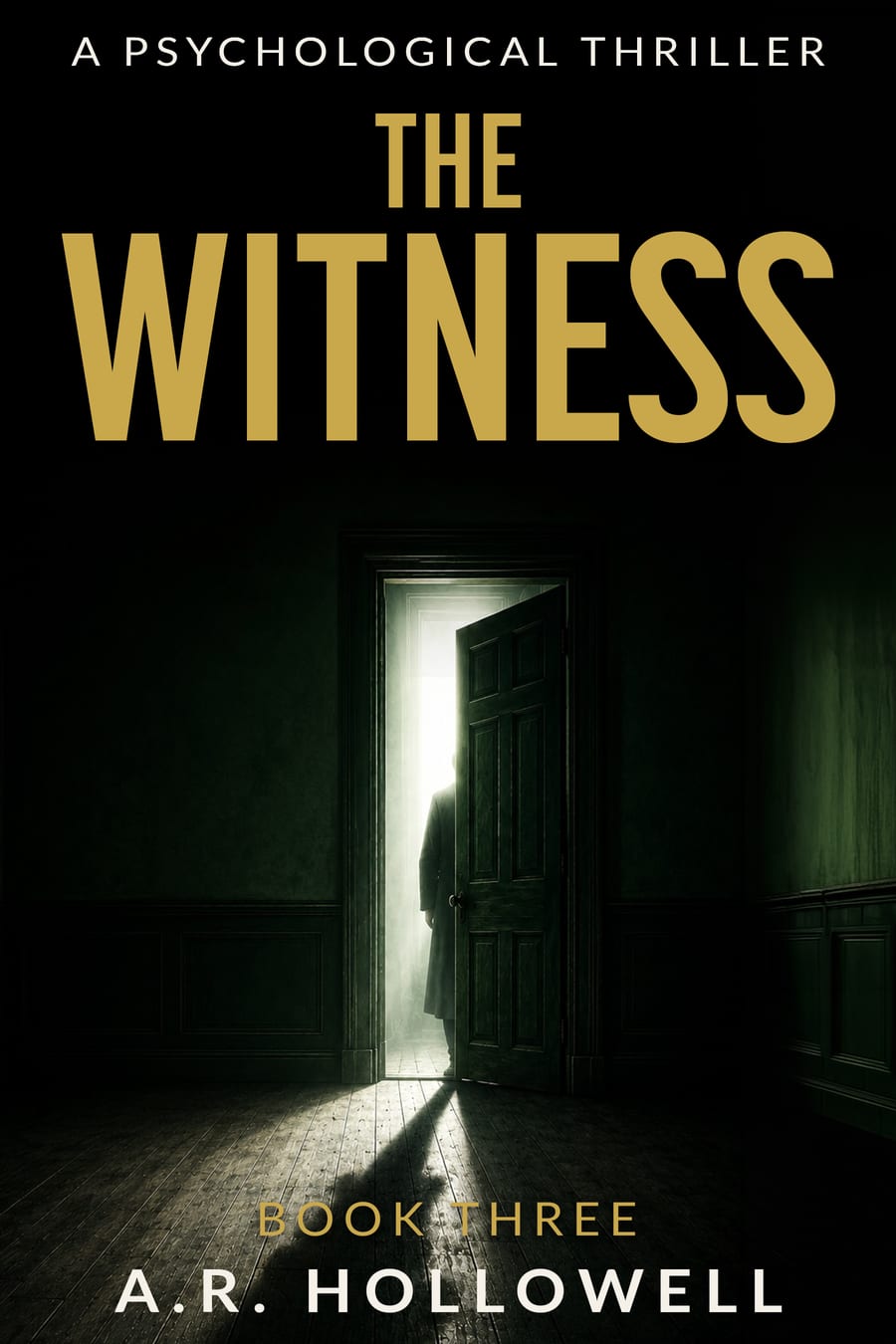


Book Three · The Hollowell Moral Thriller
“A witness trusted her with the truth. The law says she has to take it to her grave. Someone is making sure she does.”
The Witness
Book ThreeThe Hollowell Moral ThrillerA.R. Hollowell
“A witness trusted her with the truth. The law says she has to take it to her grave. Someone is making sure she does.”
Listen to the blurb
0:00/1:30
Therapist Elena Vargas has her license back and guards one rule she paid for in full: what comes into the room stays in the room.
Then a shaking stranger tells her what he has never told anyone. He knelt on Sheridan Road and held a dying Ryan Hollowell, who kept trying to say something as rain fell on his face. As the car that hit Ryan sped north, the stranger saw what the driver’s trial missed: there was a second person in it.
The instant the words are spoken, they cross to Elena’s side of a line she cannot uncross.
Three days later, the stranger misses his session, and Detective Luis Reina asks, “Did he say anything to you I should know about?”
The last time Elena broke a patient’s confidence, it took everything she had. This time, the silence is closing in on her.
Now she can dial the number Reina left and burn down the career she clawed back, or keep the stranger’s words sealed and let the passenger in that car go free.
A tense, emotional psychological thriller about complicity, a truth buried for years, and the final reckoning for the night on Sheridan Road.
The Witness is Book Three of the Hollowell Moral Series.
For fans of Jodi Picoult, Lisa Scottoline, and Liane Moriarty.
Get your copy
Save it on GoodreadsKindle: read free with Kindle Unlimited · Signed by hand, U.S. delivery · Save on Goodreads
At a glance
- Climactic moral thriller
- Hidden contracts
- The weight of complicity
- Final consequence
- Twist ending
- Moral reckoning
The Witness
$2.99Kindle
- Pages
- 206
- Published
- August 15, 2026
- ISBN
- 979-8995749875
- Publisher
- Armitage Press
- Series
- The Hollowell Moral Thriller · Book Three
The complete series
Also in The Hollowell Moral Thriller

Book One
The Privilege
Kindle Unlimited
Book Two
The Testimony
Kindle Unlimited- You are here
Book Three
The Witness
Kindle Unlimited
Praise for The Witness
A.R. Hollowell’s emotional precision, layered perspectives, and thoughtful pacing make this book impossible to put down. It’s a gripping, deeply felt conclusion to the series that stays with you long after you finish.
Case file · Chapter One
The Witness
7 min read
The new intake was nine minutes late, and Elena had spent all nine of them learning what she could from an empty chair.
Westside Community Counseling had once been a laundromat, and on quiet afternoons the room still gave it away: the drains capped under the linoleum, the long scar in the floor where a row of machines had stood. Gloria had painted the walls a beige that wanted to be calming and landed on institutional. Plastic stacking chairs. A water cooler that ticked. The poster Gloria refused to take down: HEALING IS A JOURNEY in a font designed by someone who had never needed healing. Above it all, the fluorescent tubes, humming the single flat note they had hummed since the day Gloria handed Elena a key and said, You’re a clinician again. Act like one.
Dr. Vargas again. Her license had been reinstated in April. The public, the parts of it that remembered her name, still thought revoked, and Elena had stopped correcting them. Correction was a kind of explaining, and explaining was a tell.
In the bag at her feet was what she carried into the spring and went on carrying: a single sheet in a convicted man’s steady hand, with a second paragraph on the back that rearranged the first. Thomas Crane wrote it to give her what the trial would not. She read it that morning in the car, as she did most mornings, and folded it away again, learning once more that folding it away was not the same as being done with it. It was not done with her.
She had the intake sheet on her knee. Dennis Cole. The handwriting was cramped, pressing hard enough to dent the page. Forty-three. Self-referred. Under reason for visit, he had written one word and then crossed it out so thoroughly that the paper had torn, and written instead: Can’t sleep. Other things.
The other things were the appointment. The not-sleeping was the door.
When the buzzer went, she stood and opened it before the second ring. The man in the hallway flinched as if caught at something.
He was ordinary in the way that made people forgettable: medium build going soft at the middle, a windbreaker too warm for May, a face you would pass on the platform and never assemble into a memory. He had shaved badly. His hands would not stay still. He pressed them flat against his thighs, and they slid off, and he pressed them flat again.
“Mr. Cole. Come in.”
He sat in the plastic chair and looked at the second one as if deciding whether it could be trusted, then looked at her hands, which Elena had learned to keep open and visible because frightened people read hands before they read faces.
“You’re the therapist.” Not quite a question.
“I am.”
“I almost didn’t come up. I sat in the car.” He laughed, a short dry sound with nothing in it. “Forty minutes. I do that now. I sit in cars.”
Elena said nothing. She had a notepad, and she did not pick it up. The waiting was the oldest instrument she owned, older than the training, older than any technique she could have named for him, and she had relearned how to do it without performing it. She let the fluorescent hum fill the room. She let him decide.
“I read about the trial,” he said.
“Which trial?”
“The developer. The one who hit the kid on the bike and drove off.” He swallowed. “Crane. They put him in the paper again last week. Some magazine’s doing a piece. His photo, the boy’s photo, side by side.” His knee had begun to bounce. “I see that boy’s face, and I’m not in the kitchen anymore. I’m on Sheridan Road. It’s raining.”
The room did not change. Elena made certain of that, made certain her face did nothing but what it had been trained to do. But somewhere under the training, a quiet alarm had begun, the kind she had learned not to trust and had also learned never to ignore, because a man did not drive to a clinic on the west side and sit in his car for forty minutes over a story he read in the paper.
She saw what was coming before he did. He had come to lay something down, and the place he meant to lay it was her. Whatever it was, the instant he said it aloud in this office, it crossed to her side of a boundary she could not recross, sealed under the privilege that had already taken her license once and handed it back to her changed. Listening looked passive. It was not. It was a door she opened with her own hand, and some burdens, once through it, could never be set back outside.
She had a sentence left, perhaps two, in which she could still turn him.
“Mr. Cole.” Level, an offer, not a wall. “You came in about your sleep. We can stay with that today. There’s no rule that says you owe me more than you walked in ready to give.”
It was the correct move, and it was the comfortable one, and she heard both notes ring and disliked that the second rang at all. The redirection protected him. It also shielded her, and she had taught herself to distrust any clinical instinct that happened to leave her own conscience untouched.
He took the exit. Relief came off him like heat off a radiator. “Yeah. Okay. The sleep.” His hands went back to his thighs. “It’s bad. I’m up at three, four. I’ll be dead asleep, and then I’m awake, all at once, like somebody said my name out loud.” He wasn’t looking at her. “And then I lie there and listen. For what, I couldn’t tell you. Rain, mostly. I wait for it to rain.”
“What do you do,” she asked, “when it doesn’t come?” A clinician’s question, the kind that belonged to the safe lane, sleep hygiene, the tidy map of an ordinary complaint.
“I get in the car.” He said it as though it were the most ordinary thing in the world. “I drive. Sometimes I just sit in the lot and don’t go anywhere. It’s quieter than the bed.” Then he heard himself, a flicker of it crossing his face, and he looked at the floor.
There it was, the truth leaking out the side of the safe version while he believed he was describing insomnia. He did not hear all of it. She did.
He was already gathering himself, reaching for the jacket he had never fully taken off, the visit folding back down to the size of the single word he wrote and scored through on the sheet. A man who crossed a city to confess was getting ready to drive home with it still in him, grateful to her for the exit she left open.
She thought of the boy in the photograph, the one laid beside Crane’s in the magazine, and of how many rooms this man had likely walked out of exactly like this.
She let him get one arm into the jacket. Then she chose.
“The sleep isn’t what kept you out there for forty minutes,” she said. “You were on Sheridan Road.”
“A year and a half ago.” He said it to the floor. “Year and a half, going on more. October. I’d been at my brother’s in Rogers Park, and I was driving south, and it was that rain that comes straight down, no wind, you can’t see past the wipers.” His voice had flattened into the cadence of a thing recited in the dark many times and never once aloud. “There was something in the road. I thought it was a deer. You tell yourself deer. And then it wasn’t.”
“Take your time.”
“That’s what nobody understands.” He looked up, and his eyes were wet and furious and begging all at once. “I had all the time. That’s the thing. The car that hit him was already gone. Taillights going north, fast, gone. I was the next one there. There wasn’t anybody else on that road. Just me and him.”
Elena’s hands had gone cold. She kept them open on her knee.
“I called 911,” Dennis said. “I want that on the record, with you, whatever this is. I called. I gave my name. I stayed.” His jaw worked. “He was so young. He kept trying to say something, and the rain was coming down on his face, and he couldn’t get it out, and I got down on the road, and I got him up out of the water as much as I could, and I held on.”
The hum of the lights. The tick of the cooler. Outside, a bus laboring north on Western.
“Eleven minutes,” he said. “They told me later. Felt like one. Felt like all night.”
He pressed his hands flat against his thighs, and this time they stayed.
“I was the one who held him. And I never told anyone.”
Reader Reviews
Readers Also Ask
13 questions about this book
Question 01 / 13
What is The Witness about?
Elena Vargas has her license back and a clinic on Chicago’s west side. Then a new patient tells her they saw something on the night Ryan Hollowell died that never reached the trial. When that patient goes silent, Elena is once again holding a truth the law says she must keep.
Elena Vargas has her license back and a clinic on Chicago’s west side. Then a new patient tells her they saw something on the night Ryan Hollowell died that never reached the trial. When that patient goes silent, Elena is once again holding a truth the law says she must keep.
Yes. It is the conclusion of the Hollowell Moral Thriller Series and brings the story of Elena, Diane, and the night on Sheridan Road to a close.
It is strongly recommended. The Witness resolves threads from The Privilege and The Testimony, and it will mean far more after both.
It is told in the third person and follows three women on separate threads, Elena among them, as their paths move toward the same buried secret.
Mostly in Chicago, including Elena’s new clinic on the west side, with threads that reach well beyond the city.
Yes. Alongside the moral dilemma there is a real investigation, with shell companies, missing records, and deaths that do not add up.
No. Deaths in the story are discovered and investigated rather than shown in detail.
There are no sex scenes, and the language is mild, with no f-words.
Grief, investigation of deaths that were ruled suicides, including a hanging discussed after the fact, financial crime, and threats against a witness.
Yes. The Witness is written as a true conclusion. The central questions are answered and Elena’s story reaches its end.
About 223 pages, roughly 72,000 words, in 51 short chapters across three parts: The Session, The Shape, and The Name.
Readers of Jodi Picoult, Lisa Scottoline, and Liane Moriarty, and anyone who wants a series finale that is both a mystery and a moral reckoning.
Yes. Signed hardcover and paperback editions are available in the Signed Collection on this site, for delivery in the United States.