



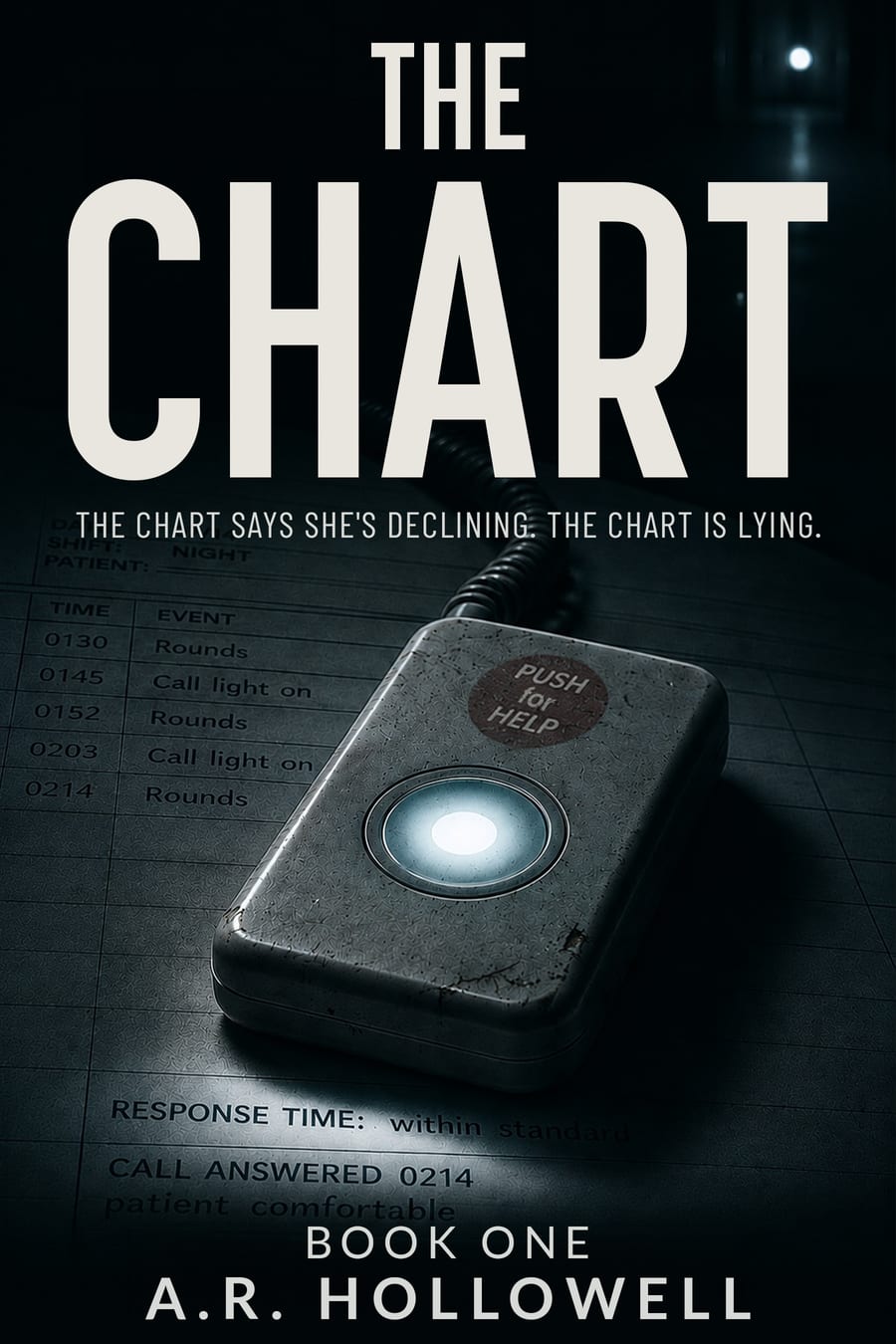


Book Two · The Hollowell Moral Thriller
“She broke the law to catch him. Now she’s being used to set him free.”

The Testimony
Book TwoThe Hollowell Moral ThrillerA.R. Hollowell
“She broke the law to catch him. Now she’s being used to set him free.”
Listen to the blurb
0:00/1:32
Elena Vargas picked up the phone and ended her career to stop a killer. She reported her own patient because a woman was going to die. It cost her license, and she is fighting to win it back.
She thought that was the worst it could get.
Then her former patient, Thomas Crane, has his lawyer send a subpoena. For the defense.
Now she has to take the stand and answer every question put to her: the remorse she observed, the sleepless nights, the hands he scrubbed raw while a mother she also treated kept asking what happened to her son.
Every word she said about his remorse is about to become his best weapon.
And that mother, Diane Hollowell, will be in the gallery fifteen feet away with her spiral notebook, listening as Elena, who once held her hand across a table, describes Crane’s suffering in the language of compassion.
Under oath, Elena can tell the truth and hand Crane a lighter sentence while Diane listens, or shade it and give the licensing board its reason to refuse her reinstatement.
A riveting psychological thriller about a witness turned into a weapon, the law used as a trap, and the price of telling the truth.
The Testimony is Book Two of the Hollowell Moral Series.
For fans of Jodi Picoult, Lisa Scottoline, and Lynette Eason.
Get your copy
Save it on GoodreadsKindle: read free with Kindle Unlimited · Signed by hand, U.S. delivery · Save on Goodreads
At a glance
- Tense legal thriller
- Legal manipulation
- Witness vulnerability
- Moral consequence
- Courtroom
- Reluctant witness
The Testimony
$2.99Kindle
- Pages
- 268
- Published
- July 15, 2026
- ISBN
- 979-8995749837
- Publisher
- Armitage Press
- Series
- The Hollowell Moral Thriller · Book Two
The complete series
Also in The Hollowell Moral Thriller

Book One
The Privilege
Kindle Unlimited- You are here
Book Two
The Testimony
Kindle Unlimited 
Book Three
The Witness
Kindle Unlimited
Case file · Chapter One
The Testimony
14 min read
Marcus was early.
Elena saw him through the window of her office, the converted storage room with the poster she still hadn’t taken down. He was walking up Western Avenue with his hands in the pockets of the gray hoodie, shoulders hunched against the October wind. He was always early now. In June, late to every session. Slouching. Radiating I don’t want to be here so loudly the waiting room could feel it. By August, on time. By September, early. Elena hadn’t mentioned it. Mentioning it would ruin it. She turned from the window and something caught at the edge of her vision, a white rectangle on Gloria’s desk, but Marcus was at the door and the session was starting. She turned to him.
She heard Gloria’s voice in the waiting room, Hey, Marcus, she’s ready for you, and then his footsteps in the hallway, and then the knock. He always knocked. Even now, five months in, he knocked on the open door before entering. You knock when you’ve spent your life in rooms where you weren’t sure you were welcome.
“Come in.”
He dropped into the plastic chair. The gray hoodie. The close-cropped hair. But the jaw was looser, less clenched. Twenty-two instead of bracing for impact. He’d started leaning back instead of forward, crossing his ankle over his knee instead of crossing his arms over his chest. The body was opening. Elena tracked these shifts without measuring them. You notice the thaw; you don’t point a thermometer at it.
“How was your week?” she asked.
“I went to the cemetery.”
Elena waited.
“First time since the funeral. Three years.” He glanced at the poster on the wall, HEALING IS A JOURNEY, and the corner of his mouth moved. The ghost of a smile. “I brought her flowers. Carnations. She liked carnations. I don’t know why. They’re the most boring flower. I told her that once and she said, ‘Marcus, boring things are allowed to be beautiful.’”
“That sounds like her.”
“Yeah.” He was quiet for a moment. His hands were in his lap, palms up, no longer guarding. “I stayed for a while. On the grass. It was cold. I didn’t care. I just talked to her. Out loud. Like she could hear me.”
“What did you say?”
“I told her about this place. About you. I told her I was talking to someone and it was helping.” He turned toward Elena. “She would have liked you. She would have said you remind her of her friend Claudette, this woman at the hospital who never talked much but when she did, everybody shut up and listened.”
Something moved in Elena’s chest. Warmer than the old tightness.
“Thank you for telling me that,” she said.
“Yeah, well.” He pulled his hoodie straight, the gesture he always made when he’d said something vulnerable and needed to recover. “Don’t let it go to your head.”
They talked for the rest of the hour. About Denise. About the cemetery. About the job Marcus had applied for at a community center on the West Side: a youth program, after-school, a place where kids who reminded him of himself could sit in a room with someone who would listen. He hadn’t gotten the job yet. He’d gotten the interview. He described it quickly, eyes on the floor, as if looking directly at hope might scare it off.
“How did the interview go?”
“I think I talked too much.”
“That’s new.”
He laughed, a real laugh, sudden and unguarded, filling the storage room and leaving it different. Five months ago, Marcus answered every question with a shrug or a monosyllable. Elena had waited, session after session: Thursdays at 3:00 PM, a storage room, and patience that the system had never offered him, that the parade of counselors and case workers with clipboards and ninety-day timelines had never thought to try. Elena offered it. And Marcus had started laughing.
At 3:50 PM, Marcus stood up. He pulled his hoodie straight again. He fixed his eyes on Elena.
“Same time Thursday?”
“Same time Thursday.”
He left. Elena listened to his footsteps in the hallway, then the front door, then nothing. The clinic was quiet. Gloria had gone home early. A dentist appointment, she’d said, though Elena suspected it was the Cubs. Gloria’s dentist appointments always coincided with playoff games.
3:52 PM. Her last session was done. She had paperwork. She always had paperwork. The clinic ran on paperwork. But the paperwork could wait. She waited until the room went quiet again. Marcus at the cemetery. Carnations. Boring things are allowed to be beautiful. The job application. The laugh. The sound of it lingered in the room, or she imagined it did, the way warmth stays after someone leaves.
She stood up and gathered her things. The desk lamp clicked off. She walked down the hallway toward the front door.
The envelope was on Gloria’s desk. The white rectangle she’d half-seen an hour ago, before Marcus, before the carnations, before the laugh that had filled the room and changed it.
White. Legal-sized. The kind that arrives from law offices and government agencies, institutions that communicate in paper because paper has authority. Elena’s name was typed on the front. The return address printed in the upper-left corner read Fisk, Hartley & Associates, 161 N. Clark Street, Suite 4200, Chicago.
She knew the name. Knew it before the thought formed, the way her hands had known the steering wheel the night she drove to Sheridan Road, the night everything changed. Gerald Fisk. Thomas Crane’s attorney. The man in the expensive suit who had faced her across the table during her licensing hearing and dismantled her career with questions so polite they sounded like compliments.
She picked up the envelope. Dense, official. Or maybe it was exactly what a legal envelope is, and the extra was hers: the old brace returning, the flinch she had learned over the past year when envelopes arrived that she hadn’t asked for.
She opened it.
Three pages. Stapled. She read the first paragraph standing in the hallway with her coat over her arm and her bag on her shoulder and the clinic dark behind her and the October light coming through the front windows, turning everything the color of rust.
You are hereby commanded to appear and give testimony at the trial of The People of the State of Illinois v. Thomas A. Crane, Case No. 2022-CR-08871, in the Circuit Court of Cook County…
She read it again.
…to testify on behalf of the defendant…
Elena’s eyes stopped on the line. Read it again. The words refused to mean what they meant.
On behalf of the defendant.
Not the prosecution. Fisk. Thomas’s defense attorney. He would put her on the stand to help his client.
She put the document down on Gloria’s desk. Both hands flat on the surface. She leaned forward and breathed: in through the nose, out through the mouth, the exercise she’d taught a hundred patients, the exercise Reeves had taught her, the exercise that works when your body wants to do something else entirely.
Fisk was calling her for the defense. His questions. His sequence. His control. He wanted the jury to hear Elena Vargas, the therapist who had treated Thomas Crane, who had listened to his confession and his remorse, describe the man she’d known. The human being. The patient who had walked into her office voluntarily and told the truth when he could have said nothing. And Elena would describe him honestly, and the honesty would be the weapon, and the weapon would be pointed at the woman in the gallery with the spiral notebook.
Fisk needed only one thing from her: what she’d been trained to do for fifteen years. Observe a human being with precision and describe what she saw. Under oath. For the defense.
And what she’d seen, sitting across from Thomas Crane every Thursday for four months, was a man in pain. A man who couldn’t sleep. A man who washed his hands until they cracked. A man who had driven away from a body on Sheridan Road and spent every day since trying to outrun the sound of the impact, the dull, wet, final sound of a car hitting a human being at forty miles an hour. He’d described it in their third session. He said he heard it every time he closed his eyes. He said it was louder in the rain.
The voice in those sessions had been singular. Not just first-person, but the kind of first-person that placed only one body in the car. The wipers, the rain, the impact, the rearview mirror, all of it filtered through one set of eyes. Elena had registered the shape at the time without naming it: clinical attention without conclusion, a detail filed before she knew what it might mean. Now, with the subpoena flat on the desk, she named it. Why would a man who had been by himself in the car return to that fact so often that the fact itself had hardened into something he was repeating?
The jury would hear that, and they’d believe her in a way they wouldn’t believe anyone else. Elena’s credibility came from the breach itself. She’d given up everything to bring this man to justice, and now she was going to sit on a stand and say: yes, he did a terrible thing. And yes, he is a human being. The jury would see a woman who had sacrificed her career to do the right thing, and then they would listen to that woman describe the defendant’s suffering, and the suffering would become real in a way no other witness could make it real.
Fisk’s play. Elegant. Devastating. And Elena couldn’t see a way around it that didn’t involve lying under oath. Every word true. Every word a weapon pointed at Diane.
Her fingers had gone cold on the desk. She noticed it the way she noticed clinical details: distantly, professionally, as if the cold belonged to someone else’s hands.
The clinic’s heating system clicked on somewhere in the walls. The sound made Elena flinch.
Diane would be in the gallery. The blue cardigan. The spiral notebook. Watching Elena take the stand. Watching Elena answer Fisk’s questions. Watching Elena describe Thomas Crane’s remorse, the humanity of the man who had killed her son and driven away and left him on the road in the dark. Diane would hear Elena say things about Thomas that sounded like compassion; they were compassion, and the compassion would feel like betrayal, and it was that too.
Elena had already betrayed Diane once: four months of silence, four months of held secrets. Eight months trying to earn back trust she knew she could never fully earn back. And now Fisk was going to use her. Again. With speech this time. With testimony. With the truth.
The privilege had been silence. The testimony was speech. The shape was the same.
And the trap had a third corner she hadn’t named yet. The transcript would land on the licensing board’s desk in April. Five board members would read about Thomas’s remorse, about Diane’s grief, about the four months she had not spoken. The same board that had revoked her license for compromised judgment would now read her testifying that the man whose secret had compromised it was, in her professional opinion, sympathetic.
Her testimony would be exhibit A in the case the board built against giving the license back.
She could make Thomas sympathetic. That was the part that made her lean harder on the desk, made her close her eyes, made the breathing exercise feel like trying to breathe through a straw. She could do it; he had been sympathetic. The remorse had been real. The confession had been voluntary. Thomas Crane was no monster, and Elena knew that better than anyone alive, and Fisk knew that she knew it, and now he was going to put her on a stand and make her say it out loud. In front of Diane. In front of the notebook and the woman who had once held Elena’s hands across a kitchen table and said, “I don’t forgive you. But thank you.”
Elena’s jaw locked. The breathing exercise stopped working. She gripped the edge of the desk and stood there in the dark hallway of the clinic where she had spent six months rebuilding a practice, a reputation, a life, and she understood that the rebuilding was about to be tested in a way she hadn’t imagined.
She opened her eyes. Picked up the subpoena. Folded it carefully along the existing creases and put it in her bag. Zipped the bag. Put on her coat. Turned off the hallway light. Locked the front door.
The October air was sharp. The trees along Western were turning, green giving way to rust. The light was low and golden, the last of it catching the storefronts and the parked cars and the bus stop bench where the old man with the Spanish-language newspaper was sitting, his coat buttoned to the throat. He nodded at Elena. She nodded back.
The bus came. She rode home with the document in her bag, the phone in her pocket, uncalled. Sharma, Margaret, Reeves: all of them would know about this eventually. Tonight, the knowledge was hers alone. She watched the city pass and let it ride beside her, like a passenger. The streetlights were coming on. The city was shifting from gold to gray.
The bus passed Fullerton. Father Brennan’s church, the steeple dark against the sky. She wondered if he still lit the candles. Probably. Priests hear a lot of confessions. They can’t carry all of them.
The bus passed Armitage. She didn’t look. She’d trained herself to keep her eyes forward; touching the bruise didn’t help. The brownstone was there. The third-floor window. Someone else’s curtains, someone else’s lamp, someone else’s patients. Her name was no longer on the buzzer. She’d checked, once, in July. Walked past and seen a different name on the panel, Dr. Sarah Kwan, Licensed Clinical Psychologist, and stood on the sidewalk and felt nothing, which was worse than feeling something. Nothing meant it was over and she’d accepted it, and the acceptance was its own kind of grief. She’d stood there for a long time. A woman on a sidewalk, looking at a buzzer panel, learning what the end of a career actually looks like when it isn’t dramatic.
She’d told Reeves about it. The nothing. Reeves had said, “Nothing is what acceptance feels like before you get used to it.” Elena wasn’t sure she believed that. But she’d stopped walking past the brownstone. She’d stopped checking the buzzer panel. She’d stopped looking for her name in a place where it no longer lived. The letting go had taken months, slow and deliberate. But the months had done their work, and the brownstone was just a building now, and the name on the buzzer was just a name.
Diversey. Almost home.
She got off. Walked the four blocks. Climbed the stairs. The stairwell smelled like someone’s dinner: garlic, onions, something with cumin. The ordinary smells of a building where people were home and cooking and living their lives without subpoenas in their bags. She unlocked the door. Freud was on the counter.
“I know,” she said. “Dinner.”
She fed him. Set her bag on the table. The three pages were inside it, folded, waiting. Something pressed through the canvas, or she imagined it did: the weight of a name she hadn’t spoken aloud since April.
She made coffee. Drank it standing at the counter. The apartment was quiet: the good quiet, the quiet she’d earned, the quiet that had taken months to stop feeling like punishment and start feeling like rest. The October light was fading. Freud ate his dinner, single-minded, unbothered, a cat who had never been subpoenaed and considered the legal system irrelevant to his interests.
The Malecón photograph was on the wall above the couch. Her grandmother’s Havana, black and white, the seawall and the waves. Her parents had given it to her after Abuela died. She studied it most evenings. The photograph reminded her that there were places in the world where none of this was happening, where her name wasn’t in a court file, where she was just Carmen’s daughter, a woman who liked coffee and cats and the sound of water against stone.
She set down the coffee. Unzipped the bag. Took out the pages and spread them on the kitchen table and read all three, slowly, carefully.
The trial was November 14th. Three weeks away.
She was going to sit on a witness stand and tell the truth about Thomas Crane. And the truth was going to help him. And Diane was going to be in the room. And the ethics board was going to be watching. And there was nothing, no law, no strategy, no breathing exercise, that could make any of those things untrue.
She folded the pages. Put them back in the bag. Washed her coffee cup. Dried it. Put it in the cabinet.
Then she picked up the phone and called Sharma.
Three rings. Sharma answered with her name, no greeting, no warmth. Sharma billed by the hour even when she wasn’t billing, and her voice never let you forget it.
“Sharma.”
“It’s Elena Vargas. I’ve been subpoenaed.”
A pause. Brief. A lawyer recalibrating.
“By whom?”
“Fisk. For the defense.”
A longer pause. Elena could hear Sharma breathing, and beneath that the faint sound of a pen being picked up, the click of a cap being removed. Sharma was writing.
“When did it arrive?”
“Today. At the clinic.”
“Trial date?”
“November fourteenth.”
“Don’t talk to anyone else about this. Not Margaret, not Reina, not your therapist. Can you come to my office tomorrow morning?”
“Yes.”
“Eight AM. Bring the subpoena.”
“Okay.”
“Elena.” Sharma’s voice shifted, just slightly, just enough for Elena to hear the person underneath the lawyer. “This is manageable. We’ll figure it out.”
“I know.”
She didn’t know. But she’d said “I know” to enough people over the past year that the words came out on their own.
She hung up. She remained at the kitchen table with the document in her bag and the coffee cup in the cabinet and Freud on the counter licking his bowl clean and the apartment going dark around her as the October sun dropped below the buildings to the west. The refrigerator hummed. A siren passed on Diversey, distant, heading somewhere else.
Freud finished his bowl and jumped off the counter and walked to Elena and pressed his body against her ankle. She reached down and scratched behind his ears. He purred. The sound filled the kitchen, small, steady, indifferent to subpoenas and courtrooms and the machinery of the law.
Twenty-one days. And then she was going to sit in a courtroom and look at Thomas Crane’s face for the first time since the last Thursday session, the one where he’d leaned forward and said, “We’re partners now, Elena.” Partners. The word had been a threat in January. The subpoena in her bag suggested it had also been a rehearsal. She was going to open her mouth and tell the truth.
Reader Reviews
Readers Also Ask
13 questions about this book
Question 01 / 13
What is The Testimony about?
Elena Vargas is subpoenaed by the defense in the trial of the man who confessed to her. Everything she observed in her office, including his remorse, can now be used to help him, while the victim’s mother listens from the gallery.
Elena Vargas is subpoenaed by the defense in the trial of the man who confessed to her. Everything she observed in her office, including his remorse, can now be used to help him, while the victim’s mother listens from the gallery.
Yes. The Testimony picks up after the events of The Privilege, and its emotional weight depends on what happened in Book One. Even the book’s description reveals how Book One ends.
Largely, yes. Much of the book is built around the trial, the cross-examination, and what happens to the people in that courtroom after the verdict.
It is told in the third person and stays close to Elena as she prepares for, gives, and lives with her testimony.
Chicago and Evanston, moving between the courtroom, Elena’s world after her career has been upended, and Diane Hollowell’s life as she waits for justice for her son.
The night of the accident is examined through testimony and evidence rather than shown as an action scene.
No. The tension comes from the courtroom, from what can and cannot be said under oath, and from the pressure on the people involved.
There are no sex scenes, and the language is mild, with no f-words.
Grief, detailed courtroom discussion of a fatal hit-and-run, alcohol, and intimidation of a witness.
The trial storyline reaches its conclusion. The final pages hand Elena something new that leads directly into Book Three, The Witness.
About 299 pages, roughly 80,000 words, in 23 chapters across three parts: The Subpoena, The Trial, and The After.
Readers of Jodi Picoult, Lisa Scottoline, and Lynette Eason, and anyone who likes legal drama where the truth itself becomes the weapon.
Yes. Signed hardcover and paperback editions are available in the Signed Collection on this site, for delivery in the United States.