
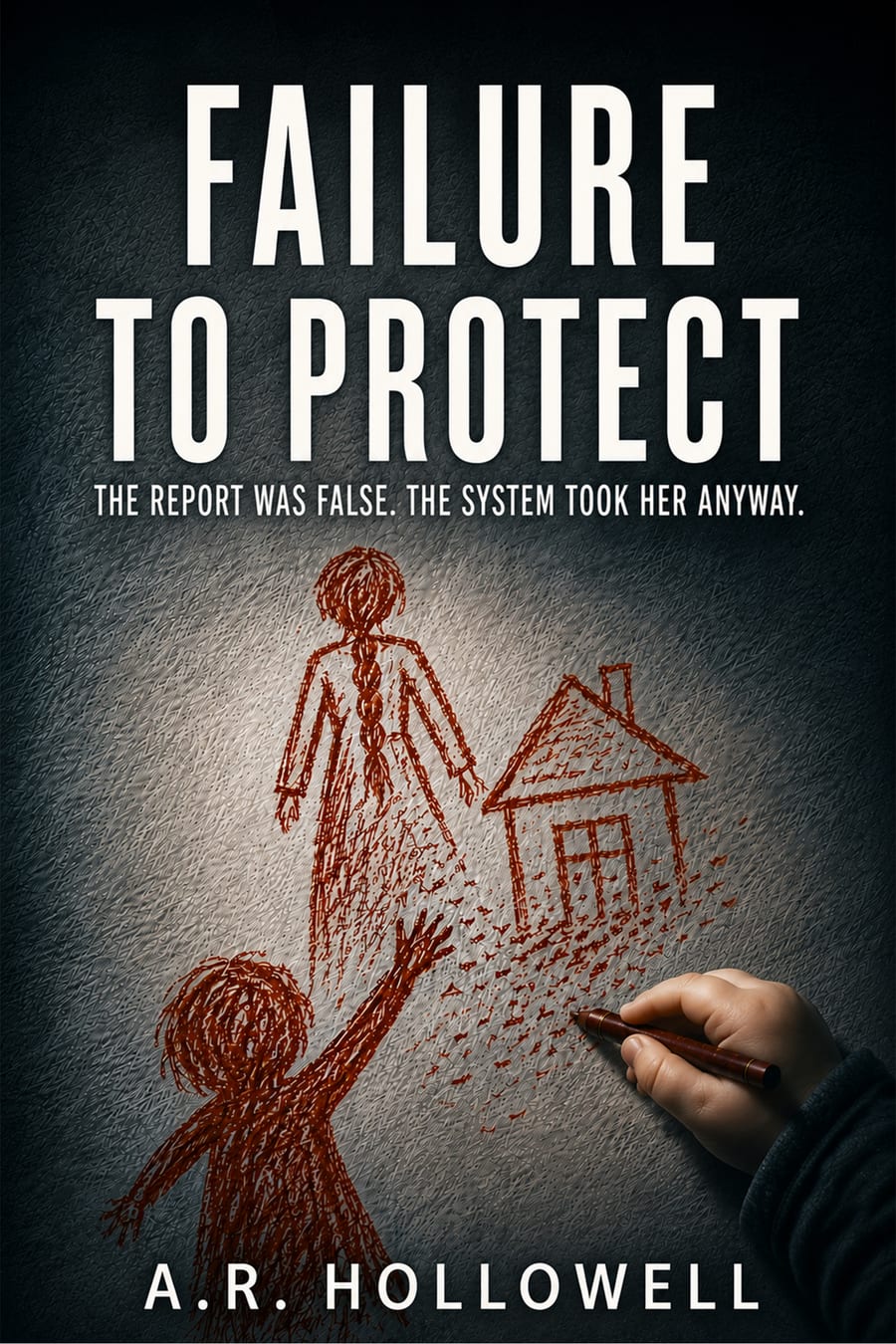

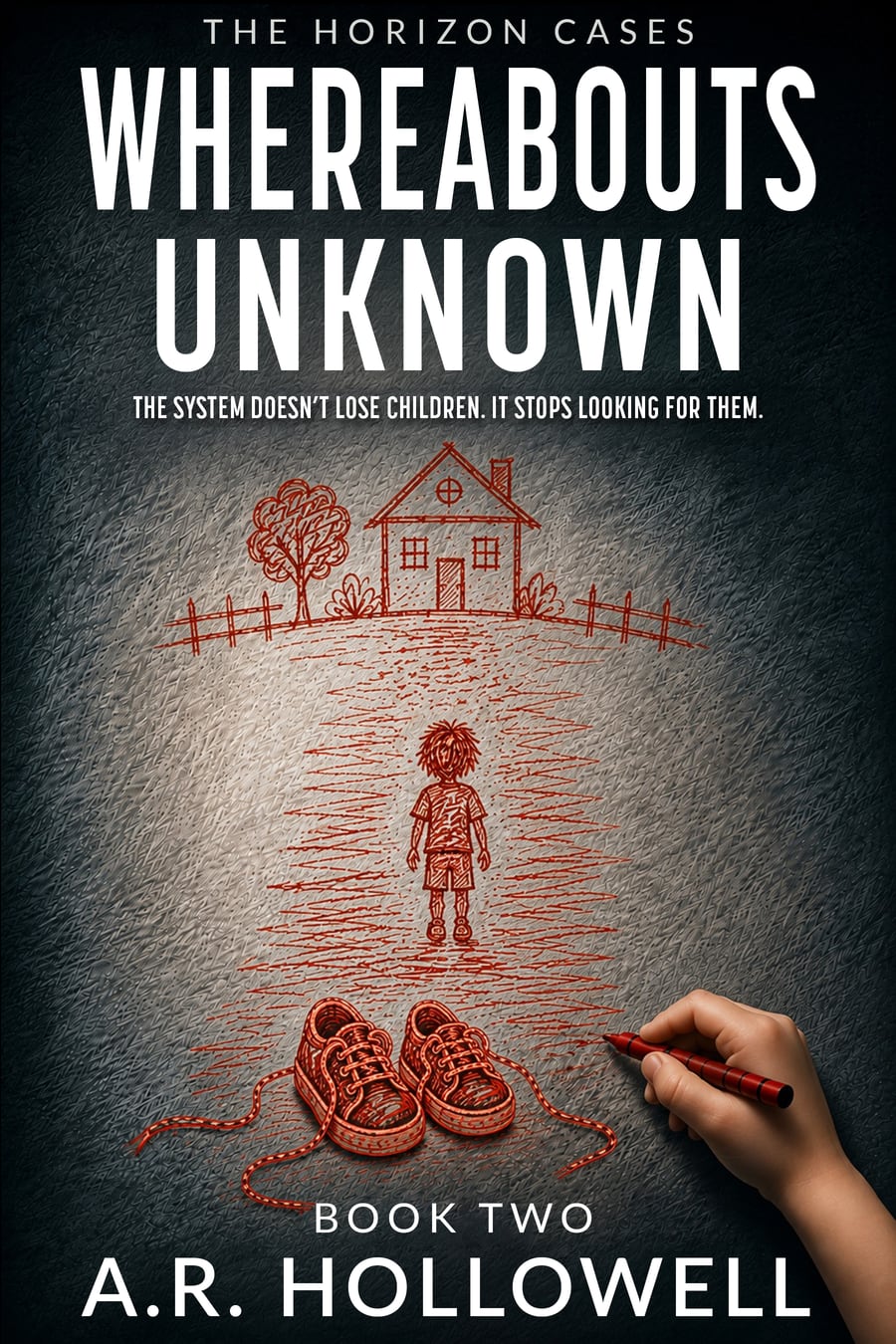
Whereabouts Unknown
Book TwoThe Horizon CasesA.R. Hollowell
“Some children don’t run. The system just stops looking.”
Listen to the blurb
0:00/1:40
Nadia Cole is sent to check on six-year-old Devon. In a cold apartment, he shows her a drawing of his mother asleep and himself beside her, “waiting for her to be up.” Nadia wants to keep him home, but one more bad night and the county has a clean bed ready.
That bed is in a group home thirteen-year-old Kayla Dunlap vanished from six weeks ago. Her file reads whereabouts unknown, and nobody is looking. To Nadia, the paperwork is too clean, and clean is how you lose a child. At the home, a girl on the stairs whispers that the boy before Kayla never ran away at all.
The case takes Nadia back ten years, to a girl of eight she argued into a group home, written off in one word: absconded. Nadia always told herself the girl ran. Believing it kept her going.
Nadia was wrong.
Then Devon is left alone after dark, and the placement desk offers that bed: “One call and he’s placed.” Nadia can sign him onto a cousin’s couch, risking her job, or make the call and send Devon into the house Kayla vanished from.
An urgent psychological thriller about the missing children a system stops looking for, the cost of a closed file, and a caseworker haunted by the girl she got wrong.
Whereabouts Unknown is Book Two of The Horizon Cases series.
Get your copy
Save it on GoodreadsKindle: read free with Kindle Unlimited · Signed by hand, U.S. delivery · Save on Goodreads
At a glance
- Urgent missing-child thriller
- Missing children in care
- The cost of a closed file
- Guilt and redemption
- Institutional thriller
- Race against time
- Past case haunts the present
Whereabouts Unknown
$2.99Kindle
- Pages
- 268
- Published
- November 15, 2026
- ISBN
- 979-8996899586
- Publisher
- Armitage Press
- Series
- The Horizon Cases · Book Two
The complete series
Also in The Horizon Cases
Book One
Failure to Protect
Kindle Unlimited- You are here
Book Two
Whereabouts Unknown
Kindle Unlimited - Pre-order
Book Three
Don't Come Out
Case file · Chapter One
Whereabouts Unknown
6 min read
Lights-out in the house is not dark. There is the hall light under the door and the parking lot light through the blinds and the little red eye of the smoke detector on the ceiling. So Kayla lies in the not-dark with her shoes on and keeps the only rule that has never failed her, which is to find the way out before she lets herself want to sleep.
She has had this room for two weeks, since they brought her back the last time she ran and moved her down the hall. She found the window the first hour. It is on the second floor, over the side yard, above the trash cans. The trash cans are the problem and also the answer, because they are loud but they break a drop. The screen is the old kind that lifts from inside if you know the tabs. She knows the tabs. She worked them out the first hour, before she learned anybody’s name. Names are not going to get you out of anything. A window might.
Window first. Nobody taught her that in words. She taught it to herself in houses before this one, by going out their windows.
She is hungry in a low, steady way that is not an emergency, just the weather she lives in now. Dinner served too early and too little and the kitchen locked at eight. She has half a granola bar in her sock and no plans to eat it. What you save is worth more than what you eat, and she has learned to want the worth more than the food. Her other things are small and hers. A folded dollar. A number she says over in her head every night, the one that reaches Simone. The number lives in her head and nowhere else. What you write down is what somebody finds. She does not write anything down.
The house counts you. Bed check at ten and again at two, a flashlight and a clipboard and a number that has to come out right. If the number comes out wrong somebody gets woken and the whole floor goes tight until it is right again. The two o’clock count is the one that checks beds instead of boxes. By two she has to be far enough gone that a wrong number cannot reach her. She does her own version too, every night before sleep. Counting the kids on this hall, who is new and who has started reading the doors like she does.
Down the hall a little one is crying.
It is the kind that still believes crying brings concern, the kind that has not learned yet that in a house like this it only brings a response. The boy came in three days ago, small, younger than her by a lot. He cries most nights around now, and the first night she almost got up.
Almost. She is not going to get up tonight either.
She has a rule about that now. It is a newer rule than the window rule and she keeps it harder, because it cost her more to learn, and she is not going to say to herself in the dark what it cost. Once you say a thing, even to yourself, somebody can sit you down and make you take it back. She only lies still and lets the crying be somebody else’s and finds the window in her head instead. She finds the tabs, the sill, the cans, the drop, over and over, until the crying is just a sound the house makes and not a face anymore.
That is what tells her it is time. Not the hunger and not the cold. The fact that she can hear a little kid cry and turn it into a sound. She was not always able to do that. She could feel herself learning it this week the way you feel a callus come up on your hand. A callus means you have been holding the same thing too long, and she is done holding it.
She has had two weeks of this house, and she has decided. She is not going to name it, not even to herself. It is what gets a girl called a liar, gets her put in a chair and talked out of her own eyes. She knows she is not going to be here long enough to find out if she is right.
She waits for the shift change. She has clocked it: the staff who does the ten o’clock walk-through is the one who does it fast, phone in her hand, checking the boxes and not the beds. The two o’clock staff is the careful one. Kayla lies with her eyes almost shut and lets the flashlight cross her and pass. She waits as long as she has learned is safe. Four hours to the two o’clock light. Then she sits up in the not-dark with her shoes already on.
At the end of the hall the last door stands open on a bed made tight, corners tucked, the blanket pulled smooth as paper, and nothing under it now. The boy who slept there left his shoes behind. They went into a box the morning after. She does not look twice.
She stands over the little one’s doorway on her way, one second, no more. He is asleep now, cried out, a lump under the blanket with one arm hanging off the cot the way little kids sleep. She could wake him. She could teach him the window and the tabs and the drop. She stands there one second and weighs it without letting herself put it into words. It comes out the same as always. She cannot carry him. She has learned what trying costs, and she is not going to pay it a second time. So she takes one second and she keeps walking. She hates the smallness of it. She has decided she can live with being small better than she can live with the other thing.
The window gives, as she knew it would. The tabs, the lift, the cold coming in ahead of her like a hand. She goes out feet first onto the sill and hangs by her fingers off the ledge over the cans.
The next window along is his. Low in it, close to the glass, there is a small face. He is not asleep. He is watching her hang there, the tabs and the lift and the sill, all of it, the whole way out. She sees him see it, and her fingers are already opening.
She lets go, and the cans erupt into noise, but she moves before the sound dies, along the fence line and into the alley.
Behind her the house sits with its hall light on and its red eye blinking and its locked kitchen, and at two the bed she left will come up as a wrong number, and the whole floor will go tight. She is not going to be there for it. She goes down the alley and turns and turns again, into the part of the city with no lights on this late and no one in it to know her name, not looking back at the window. Out here she is nobody’s. Nobody counts her. Nobody gets to decide what happens to her next.
Reader Reviews
Readers Also Ask
13 questions about this book
Question 01 / 13
What is Whereabouts Unknown about?
Nadia Cole is working a new case when she notices a thirteen-year-old girl in foster care has been missing for six weeks, coded whereabouts unknown, and no one is looking for her. The deeper Nadia digs, the more children she finds who were filed away instead of found.
Nadia Cole is working a new case when she notices a thirteen-year-old girl in foster care has been missing for six weeks, coded whereabouts unknown, and no one is looking for her. The deeper Nadia digs, the more children she finds who were filed away instead of found.
It is the term the child-welfare system uses for a child in care whose location is not known. In this book, it is also the word that lets a missing child disappear from everyone’s to-do list.
Yes. The case in Whereabouts Unknown begins and resolves in this book. Reading Failure to Protect first adds depth to Nadia’s story, but it is not required.
It opens right where Failure to Protect ends, with Nadia knocking on a door, and it picks up a thread from her past that Book One only hinted at.
It is told in the third person, braiding Nadia’s investigation with other perspectives across short, fast chapters.
In Chicago, including the Back of the Yards neighborhood, and inside the offices, files, and placements of the child-welfare system.
There is little on-page violence. The suspense comes from missing children, closed files, and the people who benefit when no one asks questions.
Missing children in foster care, children at risk, neglect by the institutions meant to protect them, and Nadia’s guilt over a child she could not save years ago. There are no sex scenes.
The language is mild, with no f-words.
About 266 pages, roughly 75,000 words, in 60 short chapters across three parts: The Code, The Search, and The Column.
Whereabouts Unknown released on November 15, 2026, and is available now.
Readers of Jodi Picoult, Diane Chamberlain, and Lisa Scottoline, and anyone who wants a thriller with a heart and a cause.
Yes. Signed hardcover and paperback editions are available now in the Signed Collection on this site.