

The Shift
Book TwoThe Meridian FilesA.R. Hollowell
“She died peacefully. That was the first lie.”
Listen to the blurb
0:00/1:43
Two women. Two Sundays. Two deaths the paperwork has already explained.
Rachel Adler sets out to prove her friend Cora James was silenced. Officially, Cora, an aide due to testify against the care chain that employed her, died of an overdose ruled self-inflicted. Then, inside Cora’s sealed envelope, Rachel finds names from three of the chain’s buildings and two words pressed through the page. Too many.
Two months later, Detective Ray Nowak, who signed Cora’s ruling, stands over Cora’s neighbor, nurse Debbie Hargrove, dead and arranged on her couch. Her shoes are squared to the wall, her hands washed clean, the pages stripped from her notebook. Still, Nowak signs the ruling: self-inflicted. Preliminary. But he is no longer sure Debbie chose to die.
Meanwhile, to place Cora’s failing mother, Gloria, Rachel can burn through Gloria’s savings on five months in a private home, or take the one bed Gloria can afford, inside the chain Cora died trying to expose. Soon a kind nurse leaves Gloria pills for the bad nights, and when Rachel reads the label, she recognizes the drug class found in Cora’s blood. Gloria has already taken one.
A chilling psychological thriller about two deaths no one wants questioned, the witnesses who pay for speaking up, and the sedatives that keep residents quiet.
The Shift is Book Two of The Meridian Files series.
For readers of Jodi Picoult, Lisa Genova, and Lisa Scottoline.
Get your copy
Save it on GoodreadsKindle: read free with Kindle Unlimited · Signed by hand, U.S. delivery · Save on Goodreads
At a glance
- Dark investigative thriller
- Chemical restraint
- Silenced witnesses
- The record as cover
- Staged death
- Detective and civilian team-up
- Corporate conspiracy
The Shift
$2.99Kindle
- Pages
- 300
- Published
- September 10, 2026
- ISBN
- 9798996899531
- Publisher
- Armitage Press
- Series
- The Meridian Files · Book Two
The complete series
Also in The Meridian Files
Book One
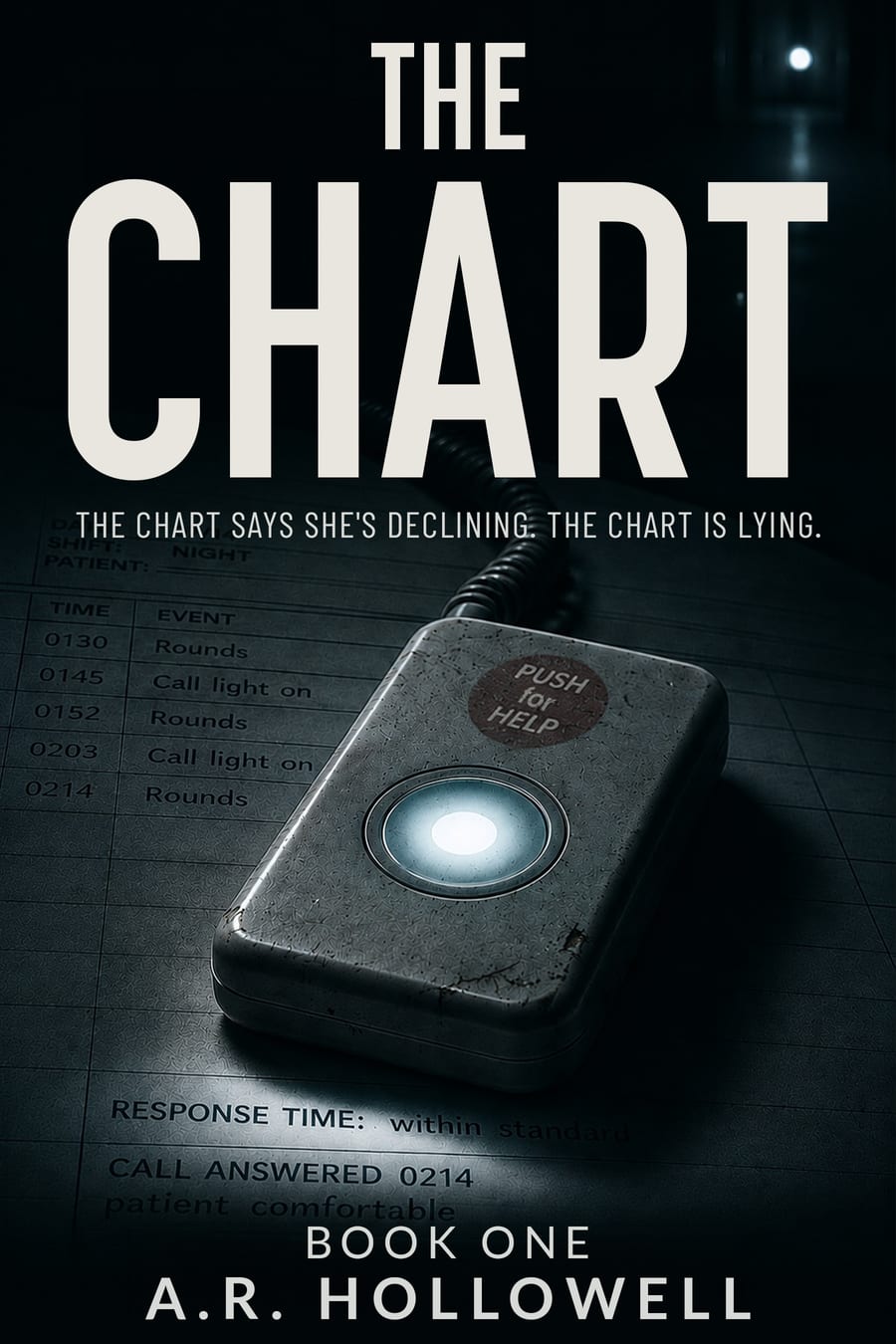
The Chart
Kindle Unlimited- You are here
Book Two
The Shift
Kindle Unlimited - Pre-order
Book Three
The Record
Case file · Chapter One
The Shift
6 min read
The woman on the couch had been dead since Friday, and the apartment was cleaner than his own.
Detective Ray Nowak stopped in the doorway and worked it from there. Twenty-six years on the job, and the doorway was still where he did his best thinking. Third floor on Elm, one bedroom, a kitchen you could cross in two steps, the trapped heat of it thick enough that the smell had done its work fast. No dishes in the sink. No mail going soft on the counter. A dish towel folded in thirds over the oven handle, the crease pressed sharp, like somebody had run a hand down it on the way past.
A Sunday in early July. The case board downtown was buried, and here he was, fifty-four years old, his knees telling him about it, standing in a dead woman’s front room reading her housekeeping.
“Debbie Hargrove,” the uniform said behind him. Young guy, gum in his jaw, matching Nowak’s, which annoyed him. “Twenty-nine. Neighbor smelled it, called it in this morning. ME’s tech is downstairs. Mother lives a few blocks up the same street. Notification’s handled.”
“Who found her?”
“Landlord let us up. Been here since Friday, they figure.”
“They figure.” He let the words sit, flat, and crossed to the couch. Did not touch. Looked.
She was arranged. That was the word that came, and he pushed it back down, because arranged closed nothing and opened everything, and he was tired. On her side, knees drawn, one hand under her cheek. A woman gone to sleep. Blanket to the waist, folded neat at the top. On the coffee table a glass with an inch of water and a pill bottle on its side, cap off, a few tablets spilled, one stuck to the wood where a wet ring had dried around it.
“RN,” the uniform offered. “Nurse, worked nights out at one of the care places. Landlord says quiet. Kept to herself.”
“They all kept to themselves,” Nowak said. “Nobody ever finds a loud one.”
He read the bottle without lifting it. A benzo, the kind that came up in half these calls. Next to the dried ring, a second script, an opioid, and the name on the label was long and clinical, a formulation, not a thing off a shelf. He sounded it out under his breath and did not know it. Somebody would run it.
A nurse carried keys to the med cart. She knew what was in it, what each thing did, and how much was too much. On a quiet floor at night it was a matter of the count and of when nobody was looking. The math wrote itself.
He hated math that did that.
He walked it again. Started at the door.
Two pairs of clogs by the mat, the white nurse kind, Danskos worn down at the outside heel. Both squared to the baseboard, toes to the wall, lined up like a locker inspection. He stood over them a second. Then he moved on.
The kitchen. A calendar taped to the fridge, drugstore paper, the boxes filled in a small hard hand. NOC for the night shift, on the nights she worked, the letters crushed together. Groceries on Tuesday. A dentist’s appointment circled twice, the date three weeks out.
He looked at it longer than he meant to. People with a date circled three weeks out were not, in his experience, the same people who lined up their shoes and lay down and stopped. But experience closed cases too, and he knew it, and he moved on.
On the counter by the toaster, a lanyard and a laminated badge. He turned it with one knuckle, did not pick it up. A name, a photo, a wordmark. Meridian. He set his eyes past it to the sink and asked the uniform nothing.
Back to the table. He crouched. His knees complained. He ignored them.
The pen.
It sat by the glass, off to the side, a cheap stick pen, black, the kind that came ten to a bag. Capped. He studied it a while. No paper on the table. No notebook. He scanned the room from the crouch, slow, and the whole apartment said she wrote things down. The torn spiral of a notebook stuck out from under the mail tray, the pages gone. Three more of the same cheap pens stood in a jar by the toaster. A grocery pad on the counter had its top sheet ripped away clean. She wrote constantly, and not one page of it was left in the room.
And the pen on the table was capped.
Nowak said, “Huh.”
“Sir?”
“Nothing.”
He stayed in the crouch. Every pen in the jar was capped. She was the kind who finished the small things. So the story was that she capped this one, set it down, and took the pills.
Except there was no paper. Nothing written, nothing to close a pen over. And a person reaching for a bottle with a spilled handful does not, in that reach, find the little cap and press it on and square the whole thing beside the glass.
Not usable. Not yet.
He stood. Walked it a third time, low, out loud, the tech in the doorway pretending not to hear. “Comes home Friday. Off shift. Takes the shoes off, squares them. Folds the towel. Sits. Takes the bottle.” He stopped at the couch. Looked at her hands, and they were clean.
He crouched again, closer, not touching. Her right hand under her cheek, the left along her hip. Nails cut down to a working length. No residue on the fingers, no chalk of a crushed tablet, no film. He had seen a lot of these, and the hands told on people. You empty a bottle into your palm and some of it stays with you, powder in the creases, a bitterness you wipe on your jeans.
Her hands looked washed.
“You touch anything?” he asked the tech.
“No, sir. Waiting on you.”
He went to the bathroom. Small, the tile a dingy yellow-white that no scrubbing brings back. One towel on the bar, faintly damp at the fold. Soap at the sink worn to a curved sliver. The sink was dry, but the drain had that faint clean smell, the pink-soap smell of a hospital corridor, and he stood there and breathed it and did not like what it did in his chest.
Washed up. Sometime Friday she had washed her hands. Then gone and lain down.
He came back out and took it all in at once, the shoes, the towel, the glass, the capped pen, the clean hands, the woman folded into sleep. For a second the room tipped and he saw it from the other side. Then his radio crackled and it tipped back, and it was a Sunday overdose again, a tired nurse in a hard job who found her way into a drawer she carried the key to.
“Detective.” The tech, holding the clipboard. “You want to call it, or hold it open?”
Held open meant a slot. It meant the lieutenant asking why, a canvass, a tox report that would come back saying exactly what the bottle already said, the board filling behind him while he chased a squared pair of shoes. He had watched it go a hundred times. The system wanted a word on the line so the next thing could move.
He took out his notebook and the stub of pencil clipped in it. He wrote the date. The name. Both scripts. The glass. The position of the body, the blanket, the shoes squared to the wall.
He did not write down the hands.
He did not write down the pen.
He stood there without writing, and the two things he had left off the page stayed with him anyway. Then he wrote self-inflicted, preliminary, and signed his name under it in the small clean letters the form asked for, and told the tech she could go, and did not look at the badge on the counter again on his way out the door.
Reader Reviews
Readers Also Ask
12 questions about this book
Question 01 / 12
What is The Shift about?
Two women who documented what happens in memory care after visiting hours are dead, and both deaths were ruled self-inflicted. Rachel Adler never believed it, and when her search collides with a detective’s case, the two deaths begin to reveal how much someone has to hide.
Two women who documented what happens in memory care after visiting hours are dead, and both deaths were ruled self-inflicted. Rachel Adler never believed it, and when her search collides with a detective’s case, the two deaths begin to reveal how much someone has to hide.
Yes, it is recommended. The Shift continues Rachel’s story and the investigation that began in The Chart.
It is told in the third person, moving between Rachel and the people drawn into the case, including Detective Ray Nowak.
In the Chicago area, inside the Meridian chain of memory-care facilities, with the trail leading to the company’s regional offices in Columbus, Ohio.
Yes. At its core is the question of what really happened to two women whose deaths the paperwork has already explained.
Deaths are discovered and investigated rather than shown in graphic detail. The menace is quiet, methodical, and very real.
Deaths staged to look like suicide and overdose, the chemical restraint of elderly residents, dementia, threats against a family, and grief.
There are no sex scenes, and the language is mild, with no f-words.
Yes. The investigation reaches a turning point, and the final pages set up a direct threat that carries straight into Book Three, The Record.
Roughly 90,000 words, in 62 chapters across three parts: The Two Sundays, The Protocol, and The Count.
Readers of Jodi Picoult, Lisa Genova, and Lisa Scottoline, and fans of slow-building suspense about institutions with something to hide.
Yes. Signed hardcover and paperback editions are available in the Signed Collection on this site, for delivery in the United States.