



The Chart
Book OneThe Meridian FilesA.R. Hollowell
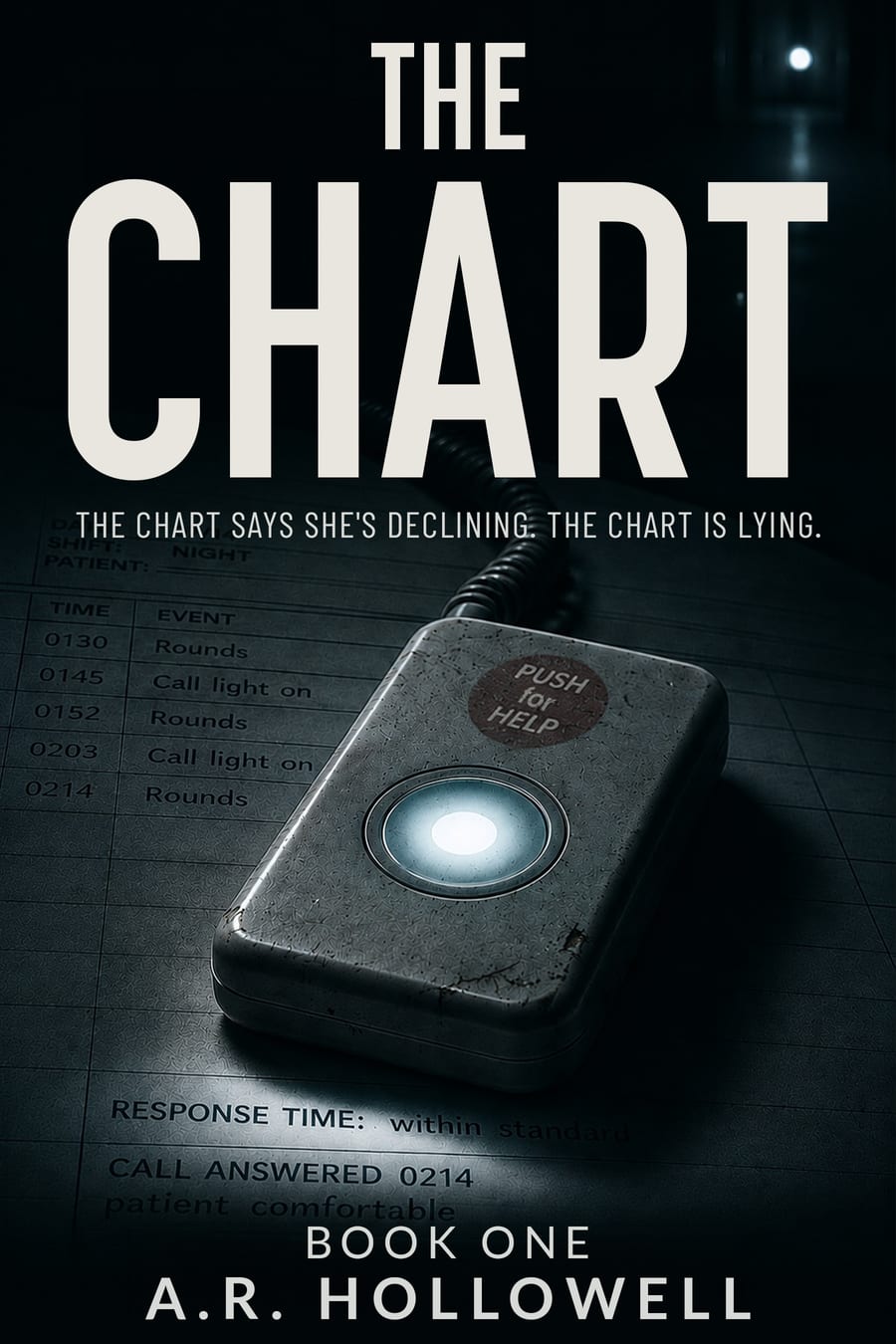
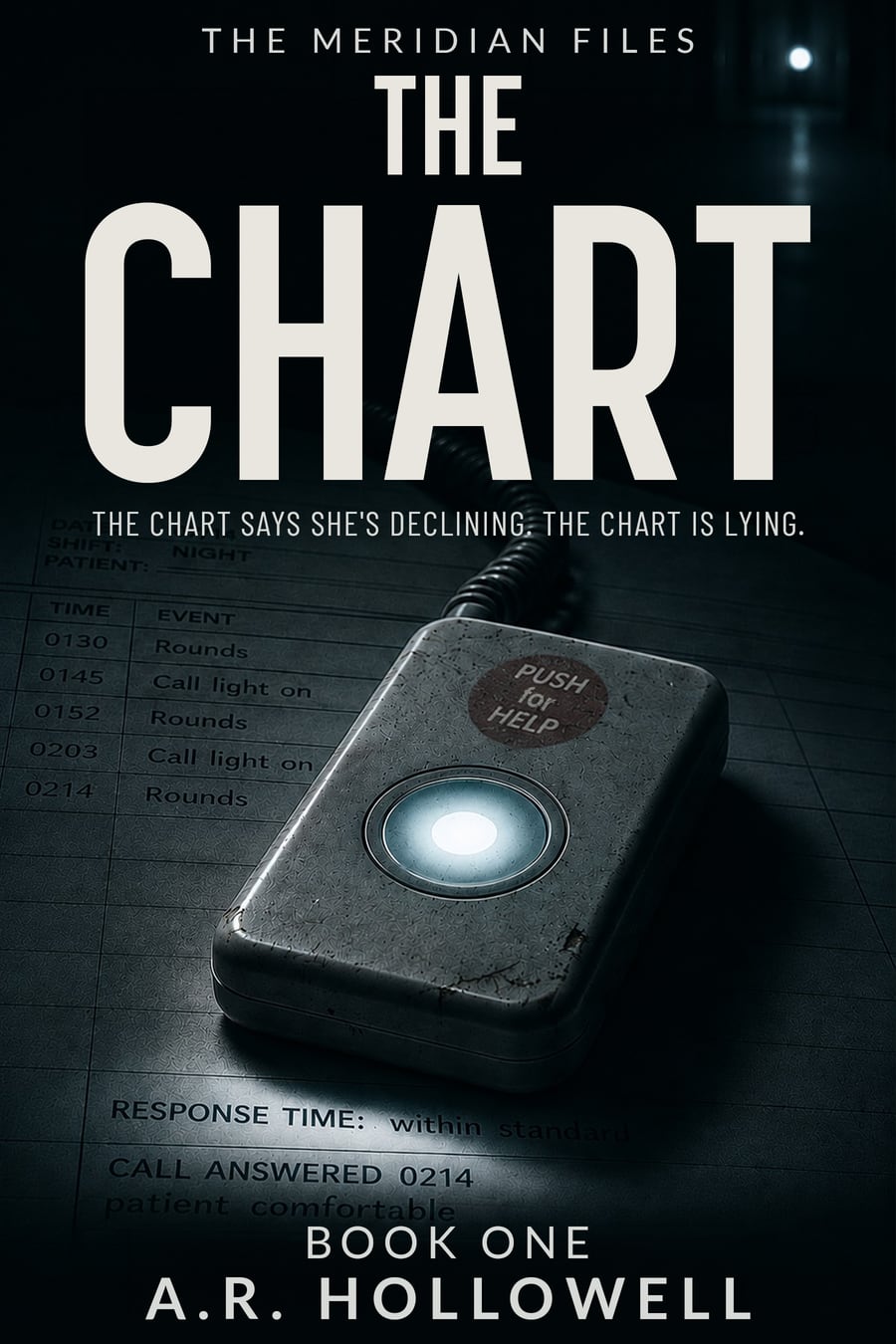
“The chart says she’s declining. The chart is lying.”
Listen to the blurb
0:00/1:43
Rachel Adler did everything right to protect her mother. She read the reviews and toured in daylight. She chose Meridian Oaks, the memory-care facility with the 4.5 stars and the lobby that smelled like eucalyptus, signed the papers, and drove home believing her mother, Helen, was safe. But one Sunday, Helen told her, “At night it’s different. There’s only one.” Then Rachel visited at night.
At 1 AM, the hallway smells like urine, and one aide, Cora James, covers twenty-six patients alone. Call lights blink in the dark, and no one comes. Helen’s water pitcher is bone dry, yet the chart says appetite adequate. “I asked but nobody came,” Helen says.
So Rachel times every call light from the chair beside Helen’s bed, to prove the gap between what the chart claims and what the hallway holds. On a night with two aides on the floor, Cora warns her, “Not every night is tonight.” Now Rachel can complain and get the line Meridian posts under every bad review, “We take all feedback seriously,” or stay quiet and build proof, night after night, while Helen waits in the dark for water.
An unsettling psychological thriller about the hours families never see, a daughter fighting for her mother, and what a chart leaves out.
The Chart is Book One of The Meridian Files series.
For readers of Jodi Picoult, Lisa Genova, and Lisa Scottoline.
Get your copy
Save it on GoodreadsKindle: read free with Kindle Unlimited · Signed by hand, U.S. delivery · Save on Goodreads
At a glance
- Quietly devastating institutional thriller
- Institutional neglect
- The document versus the truth
- A daughter keeping watch
- Institutional thriller
- Whistleblower
- Family caregiver
The Chart
$0.99Kindle
- Pages
- 292
- Published
- August 5, 2026
- ISBN
- 979-8995749868
- Publisher
- Armitage Press
- Series
- The Meridian Files · Book One
The complete series
Also in The Meridian Files
- You are here
Book One
The Chart
Kindle Unlimited 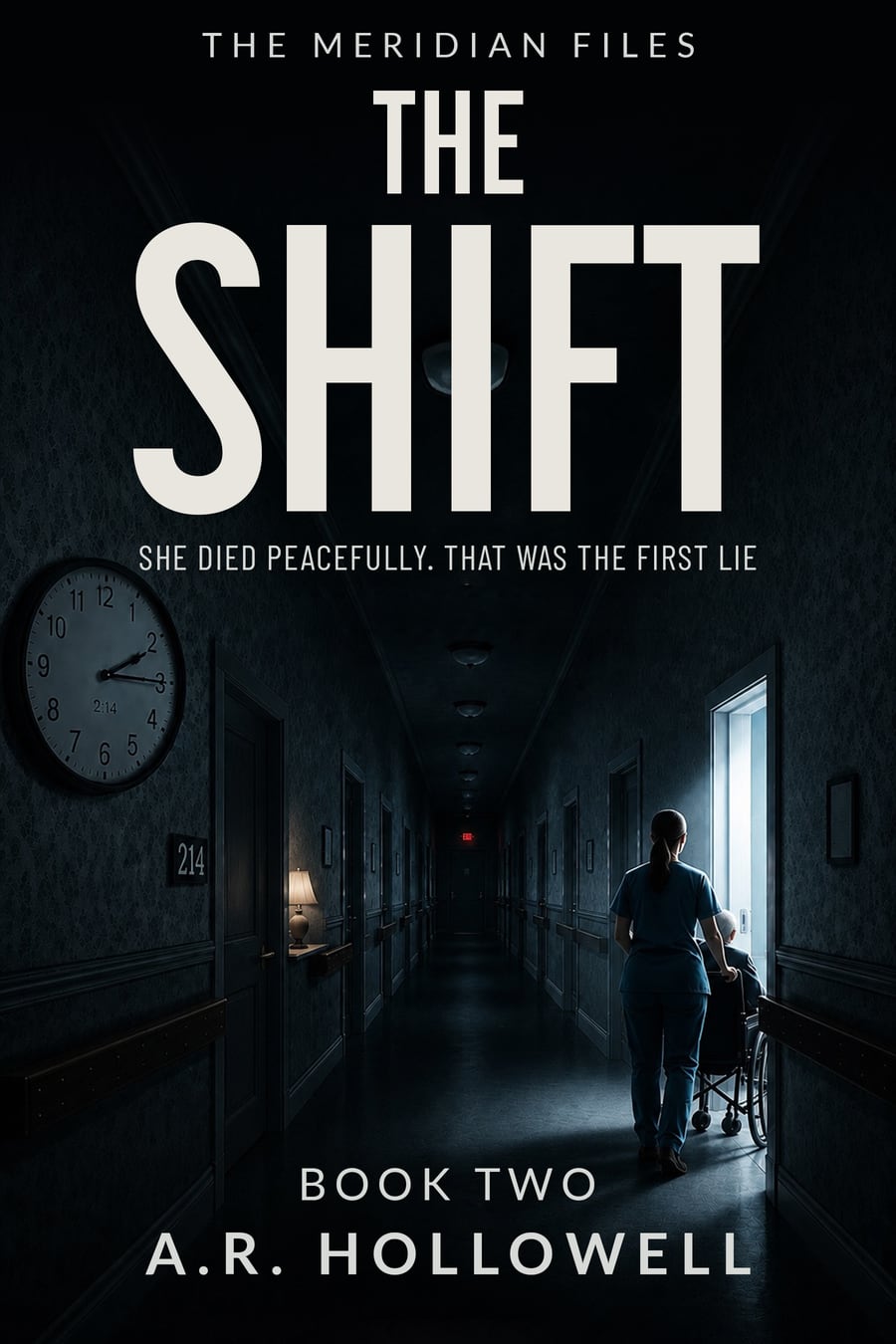
Book Two
The Shift
Kindle Unlimited- Pre-order
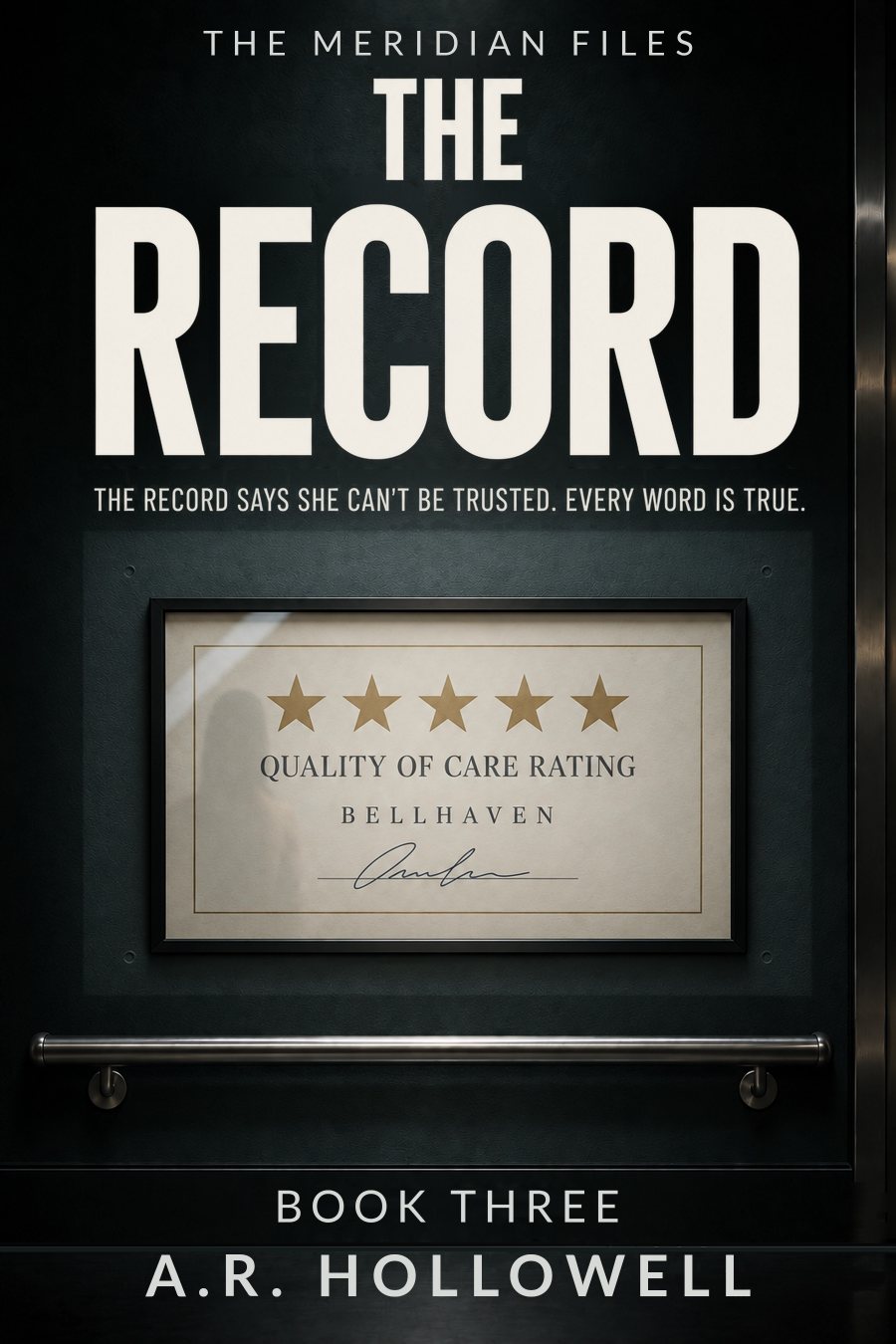
Book Three
The Record
Case file · Chapter One
The Chart
14 min read
The lobby smelled like a cover-up.
Eucalyptus first, then lavender, then citrus under that, the layers arriving in sequence, the way air freshener arrives, each scent laid down over the one before it. A diffuser on the reception desk pulsed a thin mist into the air. Rachel breathed it the moment the automatic doors parted, and her body registered before her mind did that a smell working this hard was hiding something. The floors were polished concrete, the kind that looked both industrial and expensive. A piano sat in the corner of the activities room, lid open, sheet music fanned across the stand. Chopin. Nobody was playing.
The drive took twenty-two minutes. Helen had been quiet for the last ten, watching the strip malls and the medical offices give way to the landscaped entrance, the stone sign, the parking lot with its young trees staked to the ground with wire. Rachel had turned off the radio somewhere around the third traffic light because the silence between them felt more honest than whatever was playing. Helen’s suitcase was in the trunk. The suitcase was small, almost absurdly so. A life reduced to a single carry-on, zipped shut.
“Mrs. Adler?” The intake coordinator appeared from behind the desk, clipboard in hand, smile already assembled. “We’re so glad you’re here. Let me show you to the room.”
Rachel turned to her mother.
Helen stood just inside the doors, her purse held with both hands against her stomach: the grip, the posture, Rachel’s father’s funeral seventeen years ago. She was looking at the arrangement on the reception desk: white lilies, green ferns, baby’s breath spilling over the lip of a ceramic vase.
“The flowers are fake,” Helen said.
“They’re silk, Mom.”
“That’s what I said.”
The coordinator’s smile didn’t waver. She led them down a wide hallway lined with small, framed watercolors of bridges, barns, and a lighthouse, the kind of art chosen by someone who’d been told to choose art that wouldn’t upset anyone. The carpet was new. The baseboards were clean, freshly painted. A whiteboard outside each room displayed the patient’s first name in blue marker and the day’s date in red, as if the date were a gift the hallway offered every morning. The hallway smelled like the lobby, which smelled like the brochure would smell if brochures had a scent.
Rachel had done the research. Four months of it. She’d toured three facilities and chosen this one because the activities director knew the patients’ names. The garden had a walking path with benches every forty feet, and the dining room served meals on real plates, not plastic. The rating was 4.5 stars. The state’s last survey had cited a single minor deficiency, a mislabeled bin in the medication room, corrected within a week. The Google reviews were the usual mix, and Rachel had read them all, including the negative ones buried under management responses that used the phrase “we take all feedback seriously” like a stamp.
She’d made the right choice.
Room 22 was at the end of Wing A, closest to the nurses’ station. The coordinator opened the door. The room was small but bright: a single bed with a quilt, a nightstand, a dresser, and a window facing the courtyard garden. The quilt was not hospital-issue. It had a blue-and-cream pattern, chosen to look like something a person might have at home. The bathroom had a walk-in shower with a bench and chrome grab bars. The call light was mounted on the wall beside the bed, a white plastic button with a red cross.
“This is one of our preferred rooms,” the coordinator said. “Close to the station, so the staff can check in easily. The window gets morning light.”
Helen walked to the window. She stood there, looking out at the garden. The walking path curved between raised beds. A man in a wheelchair sat near the fountain, a blanket on his lap, an aide beside him adjusting the blanket’s edge.
“There’s a man out there,” Helen said.
“That’s Mr. Paulson,” the coordinator said. “He loves the garden.”
Helen didn’t respond. She was watching the aide’s hands on the blanket: the tucking of fabric under the man’s thigh without asking, the man not reacting to the tucking. Helen watched this for a long time.
Rachel set the suitcase on the bed. She’d packed it the night before: seven days of clothes, toiletries, the mystery novel Helen had been reading, and the crossword book with the pen clipped to the cover. Helen had always dressed well, so Rachel had chosen the blouses Helen would have chosen, and the slacks with the elastic waist that Helen didn’t yet know she needed. The novel had a bookmark on page 43. The bookmark hadn’t moved in three weeks. Helen did crosswords in pen. Pencils were for people who expected to be wrong.
The photograph was in Rachel’s bag. She’d wrapped it in a dish towel; the frame was wood, old, the corners softened from years on the mantel at the house. The photograph: Rachel, Lily, the dog, the backyard. The dog was Biscuit, a golden retriever who’d died two years ago, though Helen still asked about him. It was summer in the picture, Lily ten and holding a garden hose, mid-laugh. Rachel was behind her, hands on Lily’s shoulders, squinting into the sun. Helen had taken the photograph. Helen’s shadow fell across the grass in the bottom left corner, the shape of a woman holding a camera, and that shadow remained the only part of Helen in the frame.
Rachel placed the photograph on the nightstand, angled toward the bed, where Helen could see it from the pillow.
“There,” Rachel said. “So, you can see us.”
Helen crossed the room slowly. She picked up the photograph and held it close, studying it, and Rachel realized Helen was looking at her own shadow in the corner of the frame, the shadow of the woman behind the camera. Helen touched the glass over the shadow with one finger, then set the photograph back on the nightstand and adjusted it a quarter inch to the left.
“The light’s better from this side,” Helen said. The schoolteacher’s precision, surfacing.
Helen turned from the window. She studied the photograph on the nightstand. She looked at Rachel. Something moved behind her eyes. Not confusion, not the fog that had been settling over the last year like weather rolling in. Recognition. Specific, focused. Thirty-eight years of teaching third grade lived in that focus; it surfaced without warning and left without permission, and when it was there, Helen saw exactly what was in front of her.
“You’re leaving me here,” Helen said.
Rachel’s throat closed.
“Mom…”
“I’m not asking you not to.” Helen sat on the bed. The quilt shifted under her weight. She placed her purse beside her, settled it as if testing whether the surface would hold. “I’m telling you, I know.”
The coordinator had stepped into the hallway. Rachel could see her through the open door, pretending to check her clipboard, giving them the room. The room that was now Helen’s room. The room with the quilt, the call light, and the window facing a garden where a man sat in a wheelchair and didn’t react when a stranger touched him.
Rachel sat beside her mother. The bed was firm. The quilt smelled like detergent: not Helen’s detergent, not the lavender Tide Helen had used for forty years, but something institutional that had been chosen to smell like nothing.
“The rating is 4.5 stars,” Rachel said, and heard herself say it, and heard how it sounded: like a number could hold a person, like a rating could replace a daughter.
Helen reached over and straightened the photograph on the nightstand. A quarter-inch adjustment. The teacher’s exactness intact.
“Stars,” Helen said. She smoothed the quilt with her palm. “Stars are for children.”
Rachel signed the last of the paperwork at the front desk. Eleven pages. Authorization for medical treatment. Authorization for medication management. HIPAA acknowledgment. The arbitration clause she almost didn’t sign. Her colleague at the hospital, Janet, had told her, “Never sign the arbitration clause. It means you can’t sue.” Rachel had signed it because not signing it felt like planning for failure, and Rachel was not planning for failure, because Rachel had chosen the best facility and the best facility would not require a lawsuit. Financial agreement: $7,400 per month, private pay, drawn from the sale of Helen’s house, which had closed three weeks ago, which had produced enough to cover approximately four years at this rate, which was a number Rachel had calculated on a Tuesday night at the kitchen table while Lily slept upstairs and the calculator app on Rachel’s phone showed a number that was also a countdown.
The intake coordinator handed Rachel a folder containing the family handbook, the visitation policy, the activities calendar, and the after-hours access code. She mentioned it once, quickly, a flight attendant pointing at the emergency exit, technically required, practically ignored.
“Most families visit on weekends,” the coordinator said. “Sundays are popular. We have a brunch.”
Rachel took the folder. She walked back to Room 22. Helen was sitting where Rachel had left her, on the bed, purse beside her, looking at the photograph.
“I’ll come Sunday,” Rachel said.
“Today is Wednesday,” Helen said.
“I know.”
“That’s four days.”
“I know, Mom.”
Helen nodded. Small, contained. Thirty-eight years of managing a classroom of eight-year-olds had taught her what was not negotiable, and that the not-negotiable things were the ones you nodded at; nodding was not agreement. Nodding was an acknowledgment that the thing was happening, whether you agreed or not.
Rachel kissed her mother’s forehead. Helen’s skin was cool and dry and smelled like the Pond’s cold cream she’d used every night since Rachel was a child. Underneath the Pond’s: the facility. Already. Three hours in the building and the building was already on her skin, in her hair, settling into the fabric of the blouse Rachel had chosen for her this morning from the closet in the house that was no longer Helen’s house because the house had been sold three weeks ago to pay for this room.
“I love you,” Rachel said.
“I know that,” Helen said. “That’s not the part I’m worried about.”
Rachel didn’t ask what part. She knew. Helen was worried about the hours between visits, the hours when the hallway was quiet, and the staff changed shifts, and the building became whatever it became when the families weren’t watching. Helen had been a teacher. Helen understood institutions. Helen understood that the version of a school the parents saw on open house night bore no resemblance to what the children lived in on a Tuesday in February, and that the difference between those two versions separated performance from reality.
Helen understood this, sitting on a bed in an institution, the understanding still there, surfacing inside the fog.
Rachel left. She walked down the hallway with the watercolors, the new carpet, and the eucalyptus air. She passed the activities room where the piano sat open and unplayed. She passed the reception desk where the fake flowers stood in their ceramic vase, perfect, dustless, and incapable of dying. She pushed through the automatic doors and into the parking lot.
The air outside was different. October. Cool, with the smell of leaves and asphalt and the faint diesel from the delivery truck idling at the loading dock around the side of the building. Rachel breathed it in. The October air tasted like the world, like weather, like something that changed. Inside, the air didn’t change. Inside, the air was managed.
She got in the car.
She put the key in the ignition.
She did not turn it.
Her phone buzzed in her pocket. Ben. She let it ring. He’d leave a voicemail. The voicemail would say Hey, Rach, just checking in, how’d it go? Call me when you get a chance. The voicemail would not say I should have been there. The voicemail would not say I’m sorry you had to do this alone. Ben sent money. Ben called. Ben lived in Denver, 1,700 miles from Room 22, and the distance was not geography; it was what Ben needed between himself and the look on their mother’s face when she said, “You’re leaving me here.”
The facility was behind her, visible in the rearview mirror: the landscaped entrance, the automatic doors, the sign that said MERIDIAN OAKS MEMORY CARE in brushed aluminum letters. The sign looked like a hotel. The building resembled a hotel. The brochure looked like a hotel. The 4.5 stars looked like a hotel. Everything about Meridian Oaks was designed to look like something other than what it was: a building where people went when their minds were leaving, and their families couldn’t watch it happen in the kitchen anymore.
Rachel sat in the car. The smell was on her clothes. Not the eucalyptus, not the lavender, not the curated lobby scent. Something else. Something underneath all of it that the diffuser was working to cover, and that Rachel’s nose had been catching since she walked in and that her brain had been filing under cleaning products because filing it under anything else would mean the building she’d just left her mother in smelled like a thing she didn’t want to name.
She remained in the driveway of Meridian Oaks Memory Care. She did not turn the key or drive home. She did not call Ben in Denver, who would say the rating is 4.5 stars; she’s in good hands. She did not call Lily, who was at school and who had cried last night in her bedroom with the door closed, the crying audible through the wall, the kind of crying that a fourteen-year-old does when she understands that her grandmother is not coming back to the house where the tomatoes grew and the crosswords were done in pen.
And the guilt arrived the way Helen’s fog arrived: not all at once, not dramatically, not with a sound or a sign. It arrived like weather. It settled. It became the air, and then Rachel was breathing it, and she couldn’t tell where the guilt ended and the breathing began.
She had done the right thing. The house wasn’t safe. The stove. The smoke alarm. The neighbor’s call. Helen sitting in the kitchen with the smoke alarm screaming, saying I was making tea. The doctor’s voice: the transition will be difficult, but the disease is progressing, and the home environment is no longer safe. The doctor’s voice was calm and certain and used words like environment, progression, and appropriate level of care and the words were the words Rachel used at work, at the hospital, in the meetings where they discussed patient placement and discharge planning and the words had never sounded like this before, had never sounded like a door closing on a woman who could still, in moments that arrived without warning, see exactly what was happening to her.
Rachel turned the key. The engine started. She put the car in reverse and backed out of the space. She stopped at the exit and looked in the rearview mirror one more time.
The building sat in the afternoon light, clean and landscaped, rated 4.5 stars, and inside it, her mother was sitting on a bed that smelled like someone else’s detergent, looking at a photograph that contained everyone Helen loved and no one who was staying.
Rachel drove home. The smell rode with her, in the fabric of her jacket, in the scarf she’d draped over the passenger seat, in the air of the car that had carried her mother to the building and was now carrying Rachel away from it. The smell would be in the house by the time she got home. The smell would be in the laundry. The smell would be the thing she noticed first, before the empty kitchen, before the quiet, before the crossword book that wasn’t on the table anymore because the crossword book was in Room 22 now, with the pen clipped to the cover, waiting for a woman whose hands still remembered how to hold a pen even when her mind couldn’t remember the word for Tuesday.
She pulled into her driveway and turned off the engine. She sat.
The house was dark. Lily wouldn’t be home for two hours. The dog was dead. The garden was done for the season. The kitchen window faced the driveway, and through it Rachel could see the table where Helen had sat every morning with the crossword, pen, and the coffee that she made too strong. The radio would be tuned to the classical station that played Chopin, the same Chopin that sat on the piano in the activities room at Meridian Oaks, the piano that nobody played.
Rachel sat in her own driveway as she had sat in Meridian’s parking lot: engine off, hands on the wheel, the smell on her clothes, the guilt in the car like a passenger she hadn’t invited and couldn’t ask to leave.
Four days until Sunday.
She went inside and hung her jacket by the door. She would wash it tomorrow. She would wash the scarf. She would wash everything she’d worn today because the smell belonged to the building, and the building now belonged to her mother. The belonging was what Rachel had chosen, and the choosing was what the guilt was made of.
The house was quiet in the way only a house that has lost a person is quiet. Not empty. Quiet. The quiet of a room where someone used to be and where the used-to-be is louder than any sound.
Rachel stood in the kitchen. The table had four chairs. One of them was Helen’s. Rachel had not moved it. Rachel would not move it. The chair would stay where it was, pulled slightly out from the table, just as Helen always left it. Helen believed that a chair pushed all the way in was a chair that didn’t expect anyone to come back.
Reader Reviews
Readers Also Ask
13 questions about this book
Question 01 / 13
What is The Chart about?
Rachel Adler moves her mother, Helen, who has Alzheimer’s, into a highly rated memory-care facility. Then she visits at night and finds the opposite of what the chart describes: one aide for twenty-six patients, call lights no one answers, and records that say her mother was comfortable when she was not.
Rachel Adler moves her mother, Helen, who has Alzheimer’s, into a highly rated memory-care facility. Then she visits at night and finds the opposite of what the chart describes: one aide for twenty-six patients, call lights no one answers, and records that say her mother was comfortable when she was not.
It is Book One of The Meridian Files. Its central investigation reaches a conclusion, and Rachel’s story continues in The Shift and The Record.
The Chart, then The Shift, then The Record. The books share characters and build on one another.
It is told in the third person, mainly through Rachel, alongside the night-shift aide who has been walking that hallway alone for two years.
In and around Chicago, including Evanston, mostly inside the memory-care facility Meridian Oaks, at the hours when families are not there.
Both. It is a quietly devastating institutional thriller: the suspense is a daughter documenting what happens after visiting hours and discovering how far the pattern reaches.
The story is built around real pressure points in long-term care: understaffed night shifts, charting that does not match reality, and families who only see the daytime version.
There is no graphic violence. The harm is neglect, and it is shown through small, concrete details that make it hard to look away.
Dementia, the neglect of elderly residents, the decline of a parent, overmedication, and a caregiver’s grief and guilt.
There are no sex scenes, and the language is mild, with no f-words.
About 290 pages, roughly 89,000 words, in 31 chapters across three parts: The Admission, The Pattern, and The Complaint.
Readers of Jodi Picoult, Lisa Genova, and Lisa Scottoline, and anyone who has ever trusted a care facility with someone they love.
Yes. Signed hardcover and paperback editions are available in the Signed Collection on this site, for delivery in the United States.