

Book One
“He vanishes into other men’s voices for a living. This time, the voice won’t give him back.”
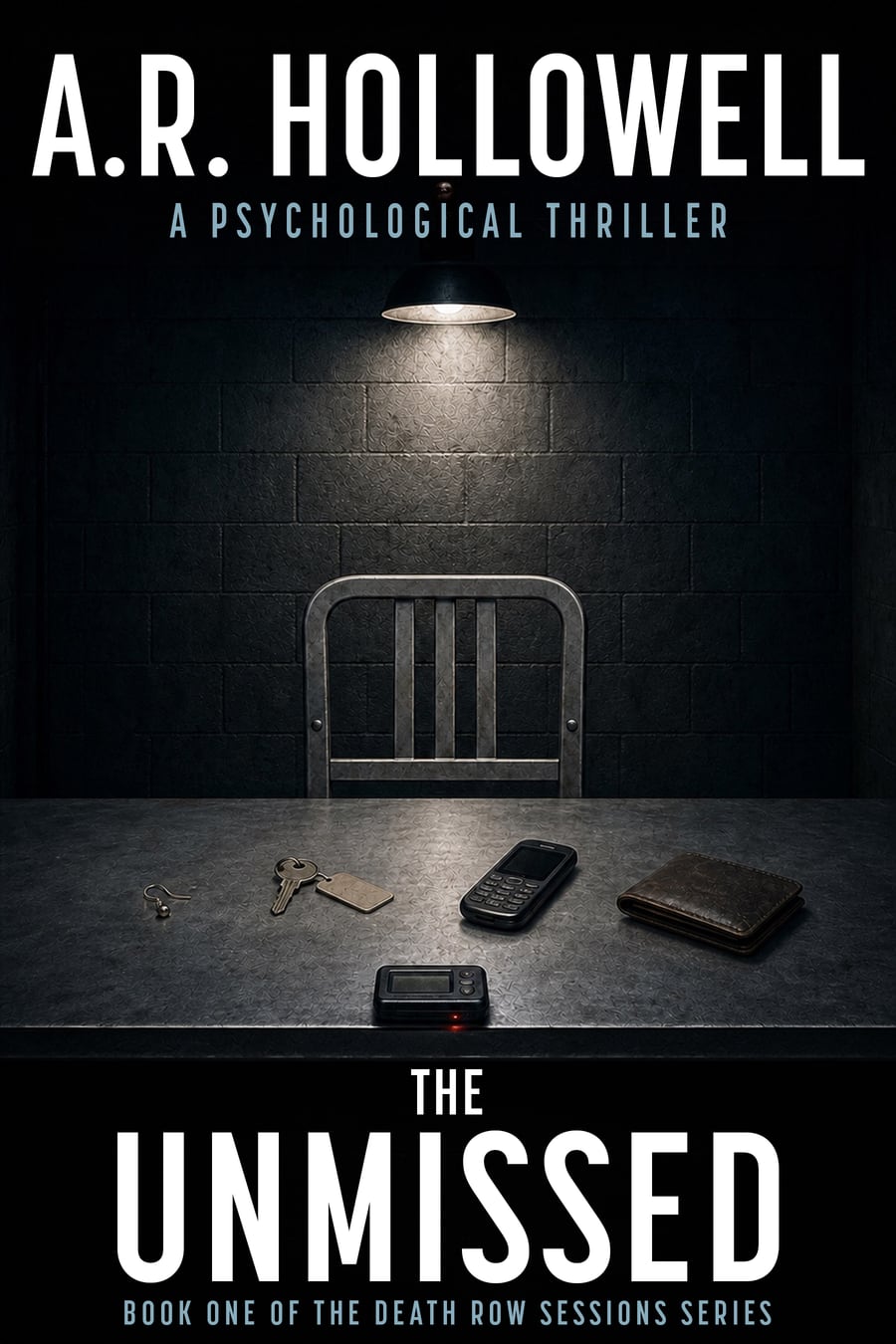
The Unmissed
Book OneA.R. Hollowell
“He vanishes into other men’s voices for a living. This time, the voice won’t give him back.”
Listen to the blurb
0:00/1:41
Elliot Marsh is a ghostwriter so good that, by his last page, a monster reads like a man you’d trust. Peter Lund, a courteous serial killer six weeks from execution, has refused every other writer and asked for Elliot by name to tell his story.
Peter confessed long ago. Now he wants something else. In a cold room, across a steel table, Peter names his price: “A page of mine for a page of yours.” Soon his calm, orderly voice begins to move into Elliot’s own, and lines Elliot can’t remember writing turn up on his legal pad, in his own hand.
Peter killed people no one would look for: runaways and drifters, the ones whose absence closes over like water over a dropped stone. Elliot calls them the unmissed. Only Peter knows where some of them lie. So Elliot can go on paying page for page until nothing of himself is left, or walk out and let that secret die with Peter.
Somewhere, a mother still sets a place at the table. This is the story of who she was waiting for.
A cold, unsettling psychological thriller about the banality of evil, the people society chooses not to miss, and the danger of listening too closely.
The Unmissed is Book One of The Death Row Sessions series.
Get Your Copy
Email me on release day
One email the day The Unmissed comes out. You’ll join the free Reader Club; leave anytime.
No spam. Just new releases and the occasional letter from the author.
Want a signed print copy? Buy a signed edition.
At a glance
- Cold, unsettling literary suspense
- The banality of evil
- Who society chooses not to miss
- Complicity of the listener
- Ghostwriter
- Death row interviews
- Unreliable voice
The Unmissed
$0.99Pre-order
- Pages
- 266
- Releases
- December 5, 2026
- ISBN
- 979-8-952267-06-0
- Publisher
- Armitage Press
The complete series
Also in this series
- You are here
Book One
The Unmissed
- Pre-order
Book Two
The Ones She Sat With
- Pre-order
Book Three
The Collector
- Pre-order
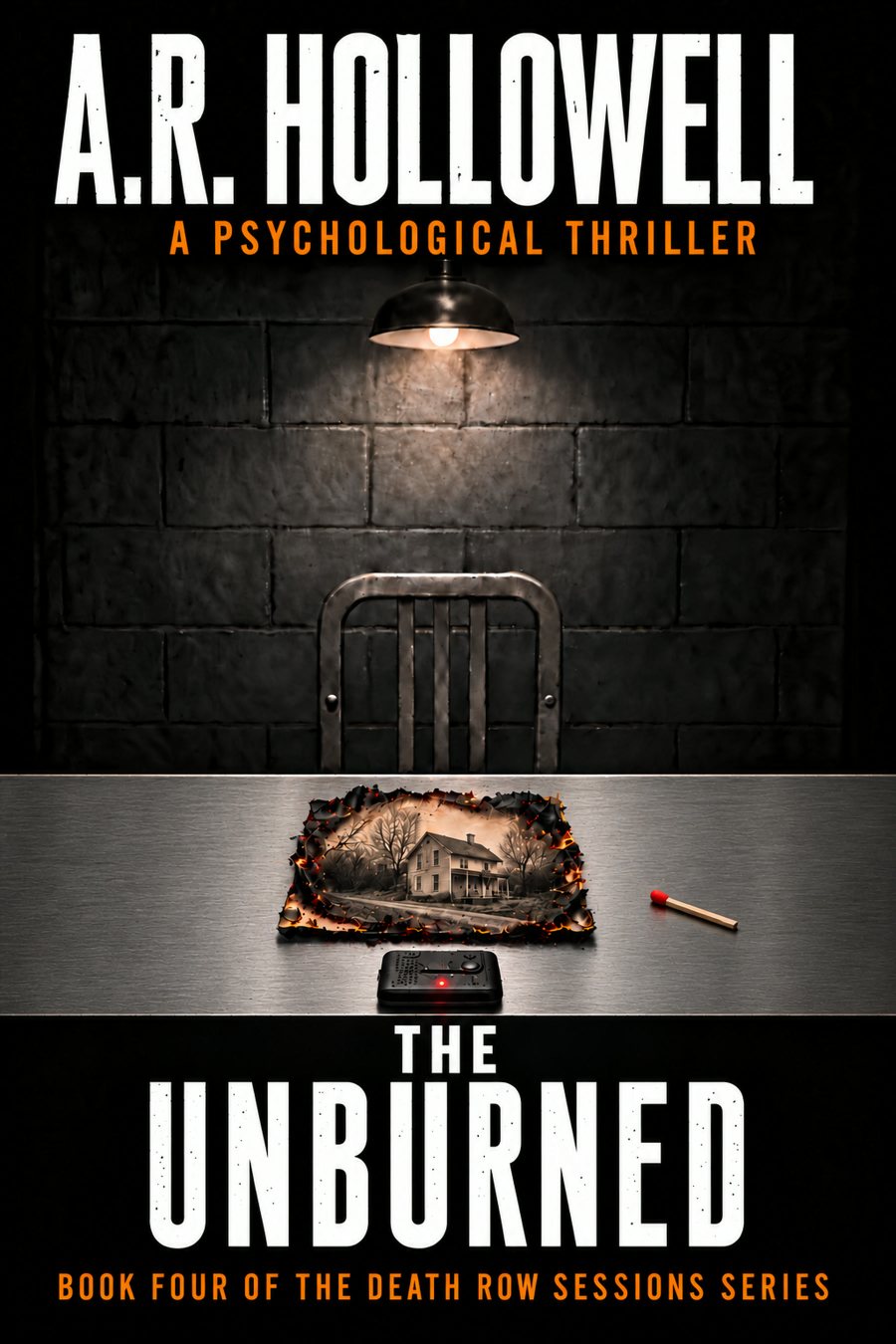
Book Four
The Unburned
Case file · Chapter One
The Unmissed
4 min read
My own words, in a mouth that is not mine.
The good sentences, the ones I was proud of, and Martin Sligh reading them back to me across a parole board’s long table. He says the line about the boy he used to be, and his voice does what my voice taught it, the little catch before the truth, the pause I built so a listener leans in and trusts the man leaning back.
They lean in.
I wrote that. I wrote the catch. I made him human on the page, and they believed it and signed the papers and opened the door. The door is in the dream too, a plain door, and it opens exactly as I built it to open.
A dial tone with no one on it. A parking lot I was never in. A name.
Dana Frey.
Not a body. The dream doesn’t have the decency for a body. A place at a table, a coat left on its hook, and behind a door I built, a woman I never met, saying my name in Sligh’s borrowed voice.
Except the name isn’t mine. It’s hers. Dana Frey, over and over, until I say it properly.
I woke with the name on my tongue like the last word of a sentence I had not finished.
The window was gray with the hour before morning, when the lamps hold on and the birds have started the day anyway. I lay still and let my heart take longer than it should to return to calm, and I took the room in. Ceiling. The water stain shaped as nothing at all. The chair with yesterday’s shirt on it. My own hands.
Six years, and the dream still comes when it wants to. Not often. Often enough. It never shows me the worst of it, only the work of my own hands.
I got up because lying there going over the dream is a way of keeping it.
The kitchen was cold. I filled the kettle and set it on and stood with both hands on the counter the way I’d stood in the night, and made myself notice the counter instead, the seam in the laminate, the ring where a mug had lived for a year before I moved it. There had been someone, until last year, who drank from the second cup. Samaira. She used to say I listened like a man taking down evidence, and she had not meant it kindly, and she had been right. I still put out two cups, every morning.
I write other men’s lives for them, and since Sligh I have kept one rule: never like a subject. I squared the coffee tin to the edge of the shelf and turned the pan handle to the wall. Her list was still on the fridge under a bank-calendar magnet, milk, stamps, the dentist, in her handwriting, with a few lines of my own at the bottom, the paper going soft at the corners. I did not touch that.
The kettle began its climb toward boiling, that low rising note a kettle makes before it means it.
I measured the coffee by eye. My hands were steady; my hands are always steady. It is the one thing about me a stranger would call reassuring, and I have used it.
Outside, a car started and didn’t go anywhere.
I went to the window. Under the streetlamp across the road a man stood in a dark coat with his hands in his pockets and his face tipped up, and as far as I could tell he was looking at the one lit window on my side of the block, which was mine. Not the street, not the cars, not the lamp over him: the window. His breath showed in the lamplight and went, showed and went. He did not stamp his feet in the cold or look up the road for a ride. A delivery van went by between us, and its lights ran over him, and he did not lift a hand to his eyes. I stepped back from the glass. A board creaked under me, loud as a spoken word, and from back by the counter I could see him, not moving, his face still turned to the window I had left as though I were standing in it yet. Then he took one hand out of his pocket, slowly, and held it up, flat, toward my window, as you show someone across a room that you have seen them. I stood in my own kitchen and listened to an engine idle somewhere down the block, and I counted to forty before I let myself look again.
The circle under the lamp was empty. The engine ran on a while, out of sight, and then it stopped, and nothing drove past, and the birds kept on.
A neighbor, I told myself. A shift worker waiting on a ride. The kettle reached its pitch and I lifted it off and poured for one, and the second cup stood empty on the counter beside the first, and the name was still there on the back of my tongue where sleep had left it, refusing the ordinary morning, waiting however long it had to.
Dana Frey.
Reader Reviews
Readers Also Ask
14 questions about this book
Question 01 / 14
What is The Unmissed about?
Ghostwriter Elliot Marsh is hired to write the memoir of Peter Lund, a mild, courteous serial killer weeks from execution. Session after session in a cold room across a steel table, Peter’s calm voice begins to move into Elliot’s own.
Ghostwriter Elliot Marsh is hired to write the memoir of Peter Lund, a mild, courteous serial killer weeks from execution. Session after session in a cold room across a steel table, Peter’s calm voice begins to move into Elliot’s own.
No. Peter was caught long ago and confessed. There is no manhunt and no chase. The suspense is what happens to the man writing his story, and what the sessions reveal along the way.
Elliot tells it himself, in the first person, which puts you inside the head of a man learning to sound like a killer.
Yes, it is a complete story. It is also Book One of The Death Row Sessions, and Elliot’s journey continues in the next books.
The Unmissed, then The Ones She Sat With, then The Collector. Each case stands on its own, but Elliot changes from book to book, so reading in order is best.
They are the people Peter chose because no one would come looking for them: runaways, drifters, people whose absence closed over without a ripple. The book is, in the end, about them.
It is cold and unsettling rather than gory. The horror comes from a quiet voice and a well-made sentence, not from blood on the page.
Crimes are recounted by the killer in a calm, controlled voice rather than staged as graphic scenes. Readers who dislike gore can usually handle it; readers who dislike disturbing ideas should know it gets under the skin.
Serial murder discussed in detail, missing persons, grieving families, the death penalty and an approaching execution, and psychological manipulation.
There are no sex scenes, and the language is mild, with no f-words.
About 290 pages, roughly 67,000 words, in 78 short chapters.
The Unmissed is on pre-order now and releases on March 1, 2027.
Readers of The Talented Mr. Ripley and Caroline Kepnes’s YOU, and anyone who likes a literary thriller that is more about a mind than a chase.
Signed hardcover and paperback editions will be available in the Signed Collection on this site once the book is released.