

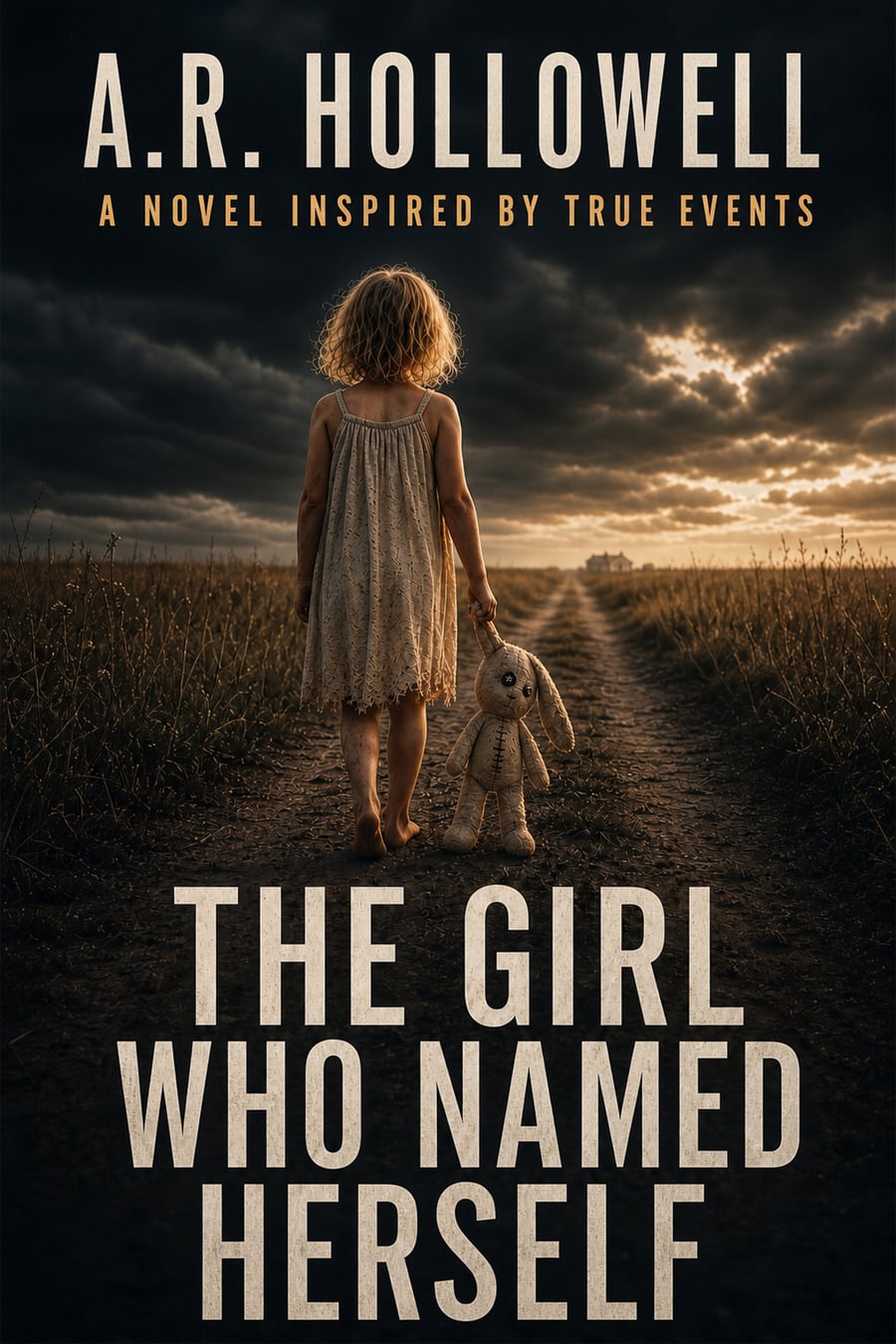
The Girl Who Named Herself
A novel inspired by true eventsA.R. Hollowell
“They taught her to disappear. She gave herself a name.”
Listen to the blurb
0:00/1:39
Every night, Jaime closes her shop and returns to the bedside of Lorene, the woman who raised her. Lorene asks, “Are you the girl who brings the towels?” No one else comes.
As a child in a house below a Chicago highway, Jaime learned hunger and the two words that followed her from home to home: don’t tell. Then, at a police station, she chose a name for herself. It belonged to the tall, strong officer who set a whole sandwich within reach and let her eat, and the girl needed that strength badly enough to borrow it. Later, in an orphanage, a nun called her too ugly to be chosen, and Jaime traced J-A-I-M-E in the fog on a window.
Even Glenn, the husband who knows her best, knows almost nothing about the child she was. Now Lorene’s memory is failing, and just the steam of a supper cart can drive Jaime into the cold, palms flat on her car roof. Jaime can keep the silence that got her through and stay half a stranger to her husband, or tell Glenn and break her oldest rule: don’t tell.
The Girl Who Named Herself is an ultimately hopeful standalone novel, inspired by true events, about surviving a childhood meant to erase her, choosing who she is, and finally breaking the silence.
Get your copy
Save it on GoodreadsKindle: read free with Kindle Unlimited · Signed by hand, U.S. delivery · Save on Goodreads
At a glance
- Devastating and ultimately hopeful
- Survival and chosen identity
- Memory and forgiveness
- Breaking the silence
- Dual timeline
- Inspired by true events
- Family drama
The Girl Who Named Herself
$2.99Kindle
- Pages
- 258
- Published
- October 15, 2026
- ISBN
- 979-8996899586
- Publisher
- Armitage Press
Follow the threads
The case board
Case notes · The Girl Who Named Herself
As a child she learned hunger, and two words: . At a police station, she . Even her husband knows about the child she was.
Point at a card to follow its threads. Click to pin it.
Case file · Chapter One
The Girl Who Named Herself
6 min read
The nursing home kept the visitor pen on a bead chain, long enough to write with and short enough that nobody could carry it off. Somebody there had thought about people like me, who might have wanted to.
The parking lot had been nearly empty when I pulled in. Two cars and the delivery van, the streetlight buzzing over them, the front of the building lit up orange behind its glass doors. Autumn had come in hard that week. The doors sucked shut and sealed off the cold, and the warmth inside had that closed-up smell places get when the windows never open. Floor polish, and under the polish something they used it to cover.
A woman in scrubs sat at the front desk with a paperback face-down beside her. She turned the ledger around for me without my asking.
“Sign in here,” she said. “Name, room, time in. You sign out when you go.”
She had a kind, worn-down face. She had watched a lot of families come through those doors, I could see it on her, and thin out over the months that followed.
“It’s a long goodbye with this one, hon,” she said. “You take your time.”
The page was ruled into columns. NAME ran the widest, built for a crowd, for sons and a daughter and the children of sons and daughters, all of them coming and going, signing in and signing out, filling the lines down the sheet across a week.
The top line was blank, and so was every line beneath it.
I picked up the pen. The chain ticked against the edge of the desk.
I held it over the line and did not write. My hand knew the shape it had to make and would not make it yet.
Then it went down and put in the letters, one and then the next, slow, the way you write a word you once had to teach yourself and never entirely trusted your hand to keep.
J-A-I. The nib caught on the third letter. I steadied it.
M-E.
Jaime.
It was not a name anyone gave me. I chose it myself, back when I was small and had nothing else to my name, and I have been writing it ever since.
The nurse read it upside down, told me the number, and pointed me down the hall.
The corridor was long and dimmed for the night. Behind one door a television laughed to itself. Somewhere a man said a woman’s name twice, patient, like he had said it many times before and would say it many more. Most of the doors stood open a crack, and most of the rooms sat dark. It was late for that place. Late was the only time I would ever come, after the shop closed.
Lorene was propped against two pillows with the blanket drawn to her waist. The television played with no sound. She was watching the door, and when I stepped in she watched me, working out which kind of thing I was and whether it would land on her.
“There you are,” she said. “Are you the girl who brings the towels?”
“I can bring some,” I said.
“They never bring enough.” She turned back to the silent screen. “You’d think a place like this would keep enough towels.”
There was no towel shortage that I ever saw. But I said I would see about it, and I meant it, because it cost me nothing and it eased her.
I carried the chair over from the wall and set it by the bed where she could see me without turning her head.
Her water cup was empty. I filled it from the pink plastic pitcher and set the straw where her hand would find it, and she drank without looking at me, trusting the cup to be there because a cup had always been there for her.
No one held a cup to my mouth when I was small, that I remember. I filled hers again anyway.
The blanket had slid off one foot. I drew it back and folded the edge under the mattress so it would hold. Her pillow had gone flat on one side, and I worked it up with my fist and settled it under her head, and she let me, easy, as she would have let anyone.
The lamp on the nightstand burned at its high setting, the kind that flattens a face down to paper. I found the little wheel and rolled it low until the glow went soft and yellow across her.
“That’s better,” she said, to no one in the room.
We sat like that. I could not tell you how long. The colors off the muted screen moved on the wall and on her face and got no further than her skin.
She talked some. Names I did not know, a woman called June, a debt somebody owed her, a screen door that would not stay latched. I said yes. I said, “Is that right?” I let her go where she went, and none of it needed me in it. She had never needed me in it. That was not new tonight.
After a while her eyes fell closed and her mouth went slack, and I thought she had dropped off.
Then she spoke, not to me, in a voice gone young and sure of itself, a voice from some kitchen window a lifetime off.
“Those boys are up on the roof again.”
I sat still.
“They’ll jump in that pool and catch their death,” she said, softer, and turned her face into the pillow, and was gone into her breathing.
I stayed until the breathing went long and even. Then I straightened the blanket a last time, out of nothing but habit, and clicked off the lamp, and left her the strip of hall light through the cracked door, as you would leave a light for a child.
At the desk the nurse had gone off down some corridor. The ledger sat open under its own small lamp, the last thing burning at the front of the house.
I found my line and wrote in the time I was leaving.
Glenn would be up when I got home. He would have left the porch light on for me, and the kitchen too, and he would ask me how she was. I would tell him she slept, and that would be true as far as it went.
If he asked why I go out there every night, I had the answer ready. I had kept it ready a long while, worn smooth from turning it over. No one else would.
It was true, and it was the kind of true you can set on a kitchen table between two coffee cups and leave there. I would tell him that one, and only that one, and let it be.
I capped the pen and let the chain drop. My name sat by itself at the top of a column built for a whole family.
Beneath it the lines ran down the page, ruled and empty and waiting. I understood I was going to fill them myself, night after night, the same name set down over and over.
Reader Reviews
Readers Also Ask
13 questions about this book
Question 01 / 13
What is The Girl Who Named Herself about?
Every night, Jaime visits the bedside of Lorene, the mother who spent her childhood telling her she was worthless. Lorene no longer recognizes her, and no one else comes. As Lorene’s memory fails, Jaime has to decide what she will finally say, to her mother and to the husband who knows almost nothing about the child she was.
Every night, Jaime visits the bedside of Lorene, the mother who spent her childhood telling her she was worthless. Lorene no longer recognizes her, and no one else comes. As Lorene’s memory fails, Jaime has to decide what she will finally say, to her mother and to the husband who knows almost nothing about the child she was.
It is a novel inspired by true events. It is adapted from a real woman’s life, with names changed and some scenes created for the novel where the details are not known.
No. It is book-club fiction told across two timelines: Jaime’s childhood and the present, at her mother’s bedside. It is devastating in places and ultimately hopeful.
Jaime tells it herself, in the first person, moving between the girl she was and the woman she became.
As a child, when every adult had a name for what was wrong with her, Jaime chose a name of her own, borrowed from a woman who looked strong. That act of choosing is at the heart of the book.
Yes. It is a standalone novel and a complete story.
Yes. It does not pretend the past was anything other than what it was, but it ends with a woman who built a life from everything meant to erase her.
Child abuse, including emotional cruelty, physical punishment, hunger, and neglect; a parent with addiction; foster and adoptive family trauma; dementia and end-of-life care; and stalking in adulthood.
The childhood abuse is told honestly, through a child’s eyes, but it is not lingered over for shock. The focus is on how Jaime survived it.
There are no sex scenes, and the language is mild, with no f-words.
Roughly 76,000 words, in 64 chapters across four parts: The Girl, The Daughter, The Stand, and The Woman.
Readers of emotional, character-driven fiction about survival, memory, chosen identity, and forgiveness, and book clubs looking for something to talk about.
Yes. Signed hardcover and paperback editions are available in the Signed Collection on this site, for delivery in the United States.