

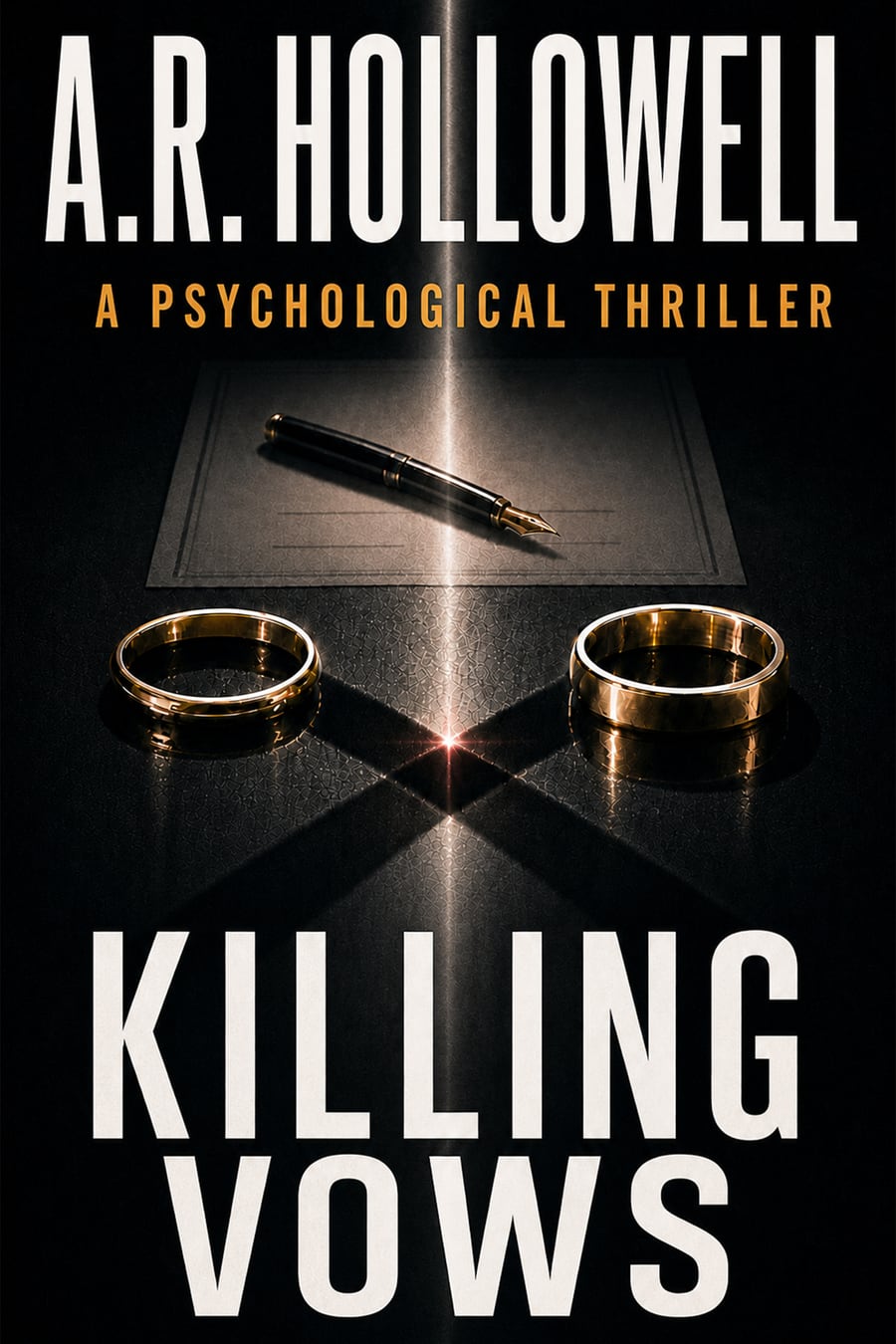
Killing Vows
“She chose the groom. She never asked who arranged the wedding.”
Listen to the blurb
0:00/1:37
Nora has spent nineteen years entering rooms under false names and leaving before anyone understands why she came. She selected Julian Ashford, beautiful, wealthy and trusting, because a bride is handed every key and his family guards a recluse who surfaces only inside their walls. Two hundred guests at Ashford House believe they are watching a love story. Nora is watching the exits. Marrying Julian gives her one night inside the estate and one chance to kill the recluse. The plan is immaculate.
Then Julian remembers a detail she never told him, a faded oxblood boathouse she read about once on a page she burned. Soon the family lawyer writes one word about her: Reconsider. At the bar, unasked, the bartender pours her an amaro she only ever wrote on a caterer’s form. Someone in Ashford House knows what Nora has never said aloud.
When the family moves dinner up, her window shrinks to twelve minutes. Yet everything is still exactly where she placed it. Now Nora can strike in a house that seems to know her better than she knows herself, or let the recluse walk out alive.
Killing Vows is a vicious, one-night standalone psychological thriller about performance, control, and a trap that feels exactly like her own idea.
Get your copy
Save it on GoodreadsKindle: read free with Kindle Unlimited · Signed by hand, U.S. delivery · Save on Goodreads
At a glance
- Sharp, darkly witty one-night thriller
- Performance and identity
- Control and its illusion
- Who is really authoring the plan
- Wedding night
- Antiheroine narrator
- Locked-in setting
- Twist ending
Killing Vows
$2.99Kindle
- Pages
- 244
- Published
- September 30, 2026
- ISBN
- 979-8996899593
- Publisher
- Armitage Press
Follow the threads
The case board
Case notes · Killing Vows
A bride is handed . Marrying Julian gives her one night inside the estate and one chance . Someone in Ashford House knows .
Point at a card to follow its threads. Click to pin it.
Case file · Chapter One
Killing Vows
5 min read
The car door opened and I located all three valets before I let anyone see my face.
Three of them. Two working, one on his phone behind the boxwood, which told me the boxwood had a gap a person could stand in and not be seen from the drive. I filed it. A bride is supposed to file the flowers.
I had spent nineteen years entering rooms under names that were not mine and leaving with no one certain why I had come, ten before anyone paid me for it and nine after. A white dress did not change the work. It only improved the access.
The ring sat a half size too tight on my right hand, sized so because a loose ring slides in photographs, and it pressed the knuckle steadily, a small fact reporting itself. The Ashfords married on the right, an old family custom Julian’s mother, Vivian, had explained as continuity. I had accepted it because my right hand was the precise one and the ring had been made for that hand.
During the vows my eyes had dropped to it once too often. Julian caught the look and closed his hand over mine, smiling as if I were frightened by the promise. For one breath the smile did not reach the rest of his face; his eyes stayed level and patient, the eyes of a man watching to see whether a plan takes. Then the warmth arrived and covered them. I let him keep the explanation. Nerves, I told myself. Grooms have them too.
Ashford House sat at the top of its own hill like something promised the view its whole life and finally collected. Limestone, lit gold, forty windows throwing warm squares onto the lawn. The rain had begun during the ceremony as a whisper and was strengthening now, faint enough that I felt it before I saw it, a thin spatter finding the tall conservatory glass off the east wing. I did not look at the windows for beauty. I sorted the ones that opened from the ones painted shut, the two on the east side propped for the caterers, in with trays every ninety seconds, out with nothing. Kitchen left, exit right, the corridor between them tonight belonging to people carrying things too fast to notice a woman leaving.
The east door. I looked at it twice, because a door you have not decided about pulls the eye back.
Then I smiled, because the photographer had lifted his camera, and tracking doors does not photograph well.
Julian was on the steps.
I will say this for him plainly, since I am not required to lie to you the way I must lie to everyone else here: he was beautiful in a way that costs three generations to make. He came down toward me and the whole front of the house seemed to lean after him, the guests, the light, the two hundred people who had driven up this hill to watch him choose me. He looked at me like I was the only accurate thing in it.
“There she is,” he said, and his gaze went down the dress and back up, slow, the way you look at something you mean to keep exactly as it is. “I’ll remember you like this,” he added, low, only for me, a groom’s line, the kind that should have warmed me. It landed a half inch to the side of warm and I could not say why. Then, lighter, the private joke: “left shoe,” about my habit of listing before I stepped. He was good at that, at building a small locked door and letting a room ache to be let in on it. My eyes crinkled on schedule.
“Here I am,” I agreed, and let him take my hands, and turned my chin a quarter inch to the left, where my face does its best work, and kissed him the instant the shutter was ready, not one instant before. You spend a kiss when it will develop.
He tasted faintly of lemon, though everyone arriving from the ceremony had been handed champagne. Lemon went into the ledger. The ledger stayed open.
A woman near the door pressed both hands to her chest. “Oh, she is glowing,” she said, to no one.
“I am,” I told her, and I was.
A man I had not met leaned past her shoulder. “The architecture student,” he said, certain. “Julian told us.” I had claimed to study architecture once, at a dinner weeks ago, never since. I nodded as if the remark belonged there and let it pass. Grooms boast. A story travels farther than you plant it.
Glow is a decision. I had decided on it during the earlier ride up the hill, before the ceremony, the same place I decided on the tremble for the toast and the tear I would spend, if I spent one, on the walk back down the aisle where the light was best. Warmth is a tool. I keep mine sharp and in a drawer, and I take it out when a room needs to be told what to feel.
This room needed telling it was watching a love story.
So I gave it one. I let Julian tuck my hand into the crook of his arm and let my eyes go soft and wet at the flowers, which were peonies, which cost what a small car costs when you buy enough to drown a staircase, and said the thing brides say about not believing it was real.
Julian leaned close, under the noise. “Nervous?”
“Terrified,” I said, and touched my throat, and released the small breathless laugh prepared for exactly this, and he covered my hand and squeezed and thought he had steadied something.
Nothing in me needed steadying. A nervous bride looks at her groom. I was looking at the room behind him: the coat check with the half door, the service stair beyond the swinging door, the terrace with the low balustrade, a fast way down if the night ever went wrong. Two hundred faces, none of them learned yet. Faces keep. Doors do not. Doors are the only thing in a strange house that will not lie to you, and the first thing I greet before I let myself be walked inside.
Julian was talking, something warm for the guests, pitched to carry to the woman who had called me glowing. I laughed at the right place, the cheapest gift you can give a man and the one that buys the most.
Behind him the caterers went in and out of the east door, ninety seconds, ninety seconds, steady as a pulse.
I checked the east door twice before I checked my reflection once. Everything was exactly where I had placed it. I did love it when a room did as it was told.
Reader Reviews
Readers Also Ask
13 questions about this book
Question 01 / 13
What is Killing Vows about?
Nora has spent nineteen years entering rooms under names that are not hers. Tonight she is the bride at Ashford House, marrying a wealthy, trusting man for one reason: it gets her inside the estate for one night and one job. Then the night starts adjusting to her moves before she makes them.
Nora has spent nineteen years entering rooms under names that are not hers. Tonight she is the bride at Ashford House, marrying a wealthy, trusting man for one reason: it gets her inside the estate for one night and one job. Then the night starts adjusting to her moves before she makes them.
Nora tells it herself, in the first person. She is sharp, funny, cold, and very good at what she does, which makes her dangerous company and hard to stop reading.
That is the fun of the book. She is the most dangerous person in the room, and you may find yourself rooting for her anyway.
Yes. It is a standalone novel and a complete story.
Over a single night, at a wedding at the Ashford family estate, from the reception until dawn.
No. It is a wedding without a love story at its center. Killing Vows is a psychological thriller about performance, control, and a trap that feels exactly like your own idea.
Very. It is built for one sitting, with short chapters and turns that reframe what you thought was happening.
Yes. There are killings, but the book is driven by tension and wit rather than lingering gore.
Murder, violence including blades, deception and manipulation, drinking at a wedding reception, and a narrator who sees people as targets.
There are no explicit sex scenes, and the language is mild, with no f-words.
Roughly 68,000 words, in 71 short chapters across four parts: The Bride, The Hunt, The Mirror, and The Vow.
Readers who love a clever, morally appalling narrator, a locked-in setting, and a twist that makes you want to start again from page one.
Yes. Signed hardcover and paperback editions are available in the Signed Collection on this site, for delivery in the United States.